
Pilot career guide
Type Rating for Pilots in India: What It Is and How CPL Holders Get One
By We One Aviation Academy · Published · 9 min read
Last updated:
Quick Answer
What is a type rating and do I need one after my CPL?
A type rating is a separate, aircraft-specific qualification endorsed on your licence, required to fly a multi-pilot or turbojet aircraft, or any aeroplane above 5,700 kg. A Commercial Pilot Licence alone does not include it — you train for it at a DGCA-approved Type Rating Training Organisation, either sponsored by a hiring airline or funded yourself before applying.
The essentials, in one view
- •A type rating is aircraft-specific, not a general licence privilege — a CPL or ATPL does not include one
- •Required for multi-pilot aeroplanes, turbojets, and any aeroplane above 5,700 kg, per DGCA's crew licensing and recency rules
- •Prerequisites: a current CPL (minimum age 18), a Class 1 medical, a multi-engine rating, a valid Instrument Rating, and English language proficiency
- •Training runs at a DGCA-approved Type Rating Training Organisation (TRTO) — ground school, simulator, then a skill test
- •It can be airline-sponsored as part of a hiring or cadet scheme, or self-funded ahead of applying
- •Cost is not standardised or published by DGCA and varies widely by aircraft and TRTO — get a written, itemised quote directly rather than budgeting off a headline figure
- •The privilege lapses without recency — a Pilot Proficiency Check within the required period keeps it usable
What is a type rating?
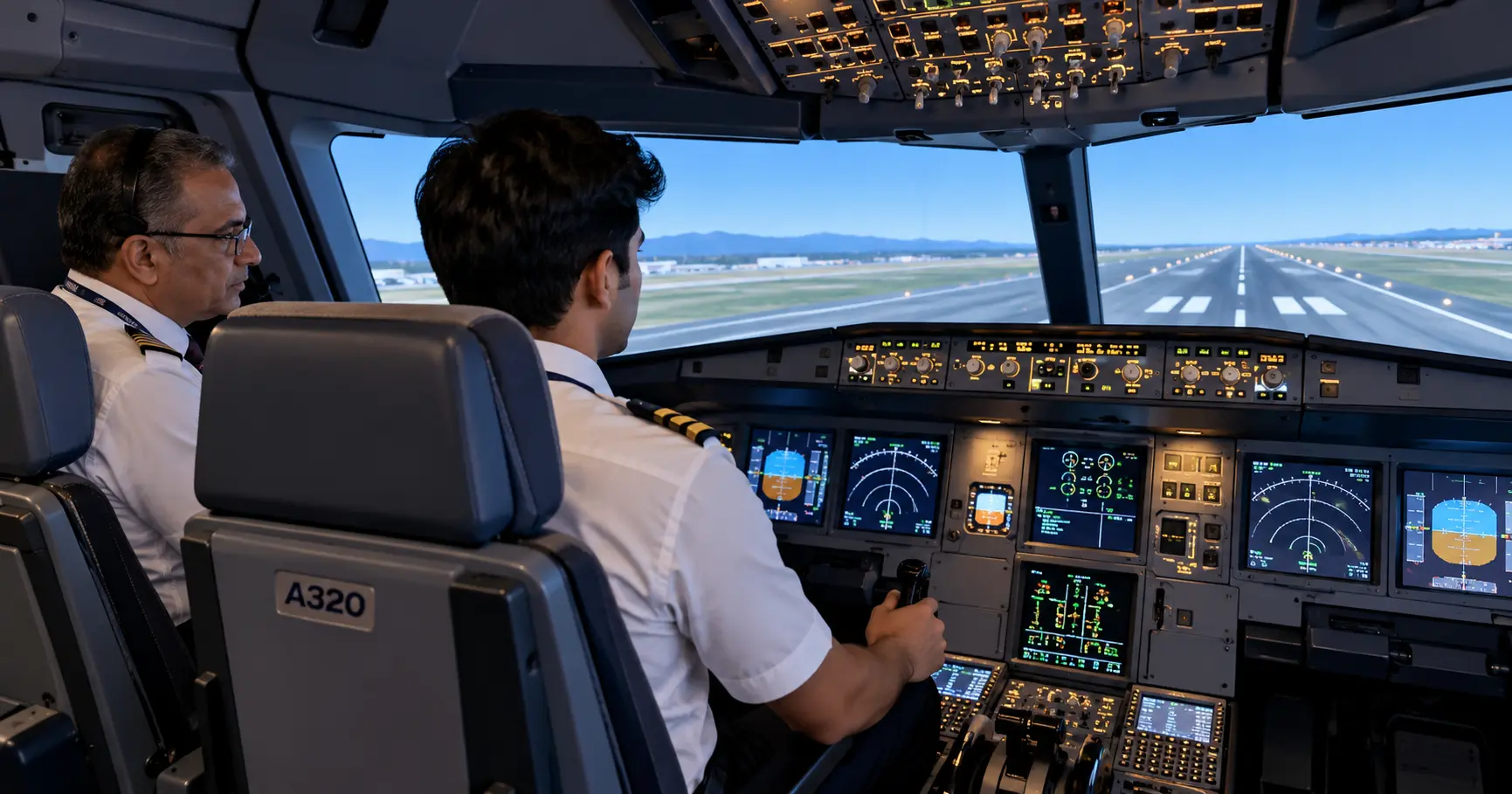
A type rating is an endorsement on a pilot’s licence certifying that they are qualified to act as a crew member on a specific aircraft type — not aircraft in general, and not even every variant of the same family. It sits on top of the CPL or ATPL rather than being part of it, and it is examined and issued separately from any DGCA written paper or the licence itself.
The distinction matters because it is the single most common gap between a fresh Commercial Pilot Licence holder and someone an airline can actually roster. The licence proves you are qualified to fly for payment in general; the type rating proves you are qualified to fly one particular aeroplane.
Which aircraft actually need one?
Broadly: multi-pilot aeroplanes, turbojet-powered aeroplanes regardless of weight, and any aeroplane with an all-up weight of 5,700 kg or more. DGCA’s crew licensing and recency material — the CAR Section 8 Series ‘F’ series governing recency and Pilot Proficiency Checks for multi-pilot aeroplanes and aeroplanes above 5,700 kg — is the applicable framework, published on dgca.gov.in. The light single-engine trainers used for CPL flying hours sit well under that threshold, which is exactly why the requirement never comes up during initial training and then arrives all at once once a candidate starts looking at airline aircraft.
What you need before you start
A TRTO will check every item below before accepting you onto a type rating course. Missing one does not fail the course — it stops you from starting it.
| Requirement | Detail |
|---|---|
| Commercial Pilot Licence | Issued by DGCA, current and unrestricted. Minimum age for CPL issue is 18 (Aircraft Rules, 1937, Section J). |
| Class 1 medical certificate | Must be current on the day type-rating training and the skill test are conducted, not merely at CPL issue. |
| Multi-engine rating | Required before a multi-engine, multi-pilot type rating, since the type rating builds on multi-engine handling rather than teaching it from scratch. |
| Valid Instrument Rating | Type rating training and checking are conducted under instrument flight rules for most of the syllabus. |
| English language proficiency | A current ICAO language proficiency endorsement, since checklists, callouts and ATC communication on type are conducted in English. |
Your 200-hour CPL flying record does not need to include any time on the target type — that is precisely what the type rating course itself is for. What it does need is to be current and unrestricted, with nothing outstanding against the licence.
How the TRTO process actually works
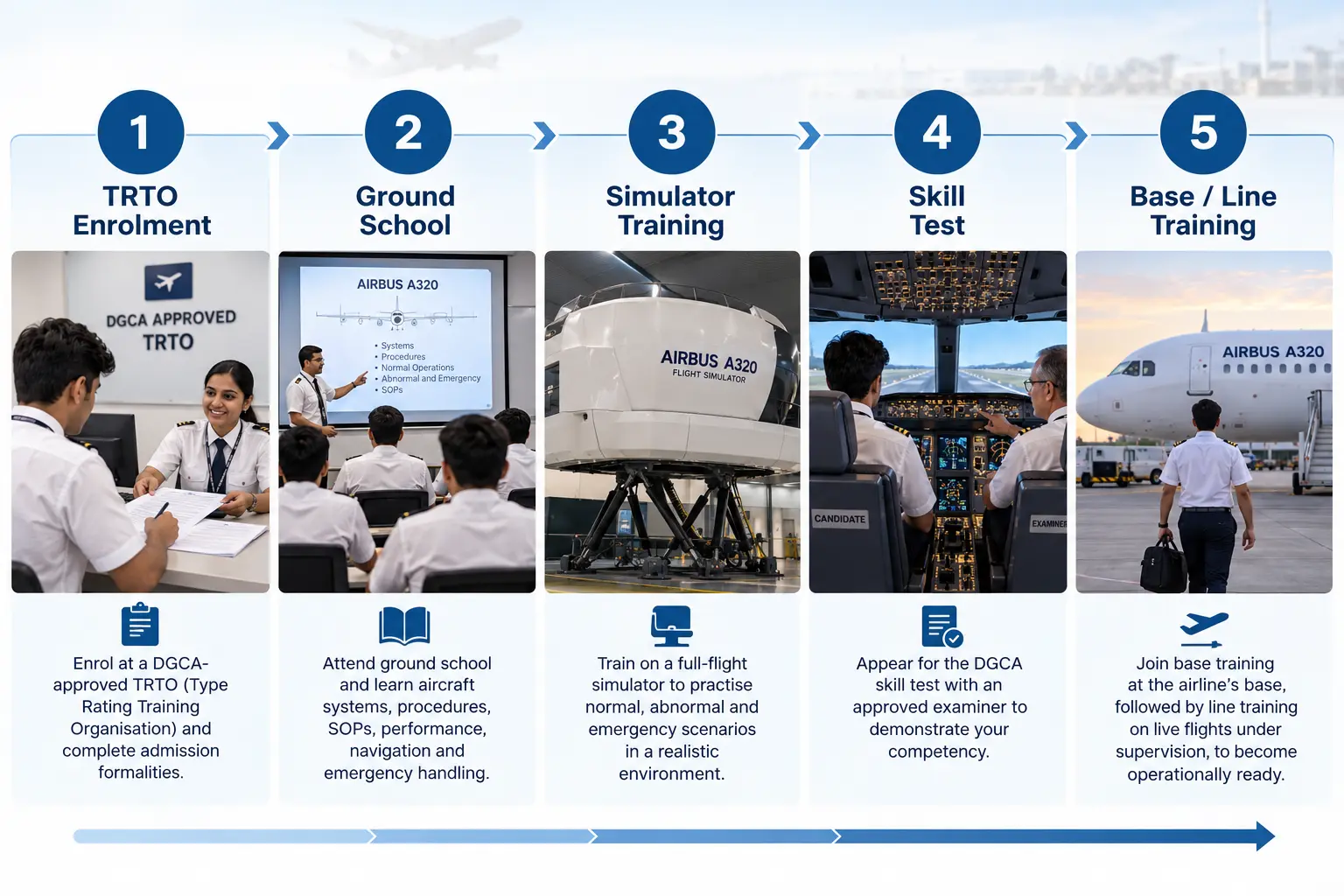
Type rating training runs at a DGCA-approved Type Rating Training Organisation. DGCA publishes its own list of approved training organisations, and confirming an operator’s current approval for the specific type and variant — not just the aircraft family — is the first check to make before paying anything.
| Stage | What it involves |
|---|---|
| TRTO selection and enrolment | Confirm the organisation holds a current DGCA approval for the specific aircraft type and variant you want, not just the aircraft family. |
| Ground school | Aircraft systems, limitations, performance and normal and abnormal procedures for that specific type, examined before simulator training begins. |
| Simulator training | Full-flight simulator sessions covering normal operations, system failures and emergency procedures, built up progressively to the skill test standard. |
| Skill test | A DGCA-authorised examiner conducts the type rating skill test in the simulator; passing it is what gets the type endorsed on your licence. |
| Base training or line training | Where an operator requires it, further training on the actual aircraft or under supervision on revenue flights follows the simulator phase before you fly the type unsupervised. |
Airline-sponsored vs self-sponsored
A type rating reaches a pilot one of two ways, and the difference changes both the financial risk and the timeline.
Under an airline-sponsored or cadet route, the operator selects candidates first and funds — or bonds — the type rating as part of onboarding, usually onto whichever aircraft it currently needs crew for. The candidate takes on little or no upfront cost, but has no choice over the type and the seat depends entirely on that operator’s own hiring decision.
Under a self-sponsored route, the pilot pays a TRTO directly and holds the rating before applying anywhere. This can shorten the path to a direct-entry first officer role at an operator that already flies that type, since some direct-entry postings prefer or require candidates arriving already rated. It also means the entire cost is at risk before any job offer exists, and a rating on a type no operator in India currently flies has very limited practical value.
What does a type rating cost?
There is no single figure, and DGCA does not publish or standardise type rating fees — each TRTO sets its own, and published estimates from different sources for the same aircraft disagree with each other by a wide margin. Rather than repeat a number that a different provider could contradict within weeks, the honest answer is: request a written, itemised quote from the TRTO directly, and confirm exactly what it covers.
At minimum, ask whether the quote includes ground school, the full simulator syllabus, the skill test itself, and any base or line training the hiring operator requires afterward. A quote that only covers the simulator phase is not the total cost of being employable on that type.
Keeping the rating current
A type rating does not expire the way a document does, but the privilege to use it lapses without recency. DGCA’s recency framework for multi-pilot aeroplanes and aeroplanes above 5,700 kg requires a Pilot Proficiency Check on that type within a set period; missing the window means retraining before the rating can be exercised again, even though it was never removed from the licence itself. A pilot who holds a type rating but has not flown that type or completed a proficiency check recently should confirm current status before assuming they can simply return to the aircraft.
Choosing which type to get rated on
For a self-sponsored candidate, the choice matters more than the training itself. A rating is only as useful as the number of operators actually flying that aircraft in the market you are applying to. Before committing, it is worth checking which aircraft the airlines you are targeting currently operate and are actively hiring direct-entry first officers for, rather than choosing a type on availability of a training slot alone.
Mistakes that waste the investment
- Paying for a type rating before confirming the TRTO’s DGCA approval covers the exact variant you need, not just the aircraft family.
- Treating a quoted fee as final without asking what it excludes — base training, line training and recurrent checks are frequently billed separately.
- Self-funding a rating on a type with little presence in the market you plan to work in.
- Letting recency lapse between the rating and an actual job offer, then discovering a proficiency check is needed before the aircraft can be flown.
- Starting the process before the Instrument Rating, multi-engine rating or English proficiency endorsement are in place, and losing a training slot to a prerequisite that could have been sorted months earlier.
Ground classes at We One Aviation
We have taught the DGCA ground subjects from Dwarka since 2009. A type rating sits well after the stage we teach, but eligibility questions like whether your CPL, medical and ratings will be in order by the time you are ready for one are exactly the kind of planning conversation we have with students long before that stage arrives.
We teach the DGCA ground subjects and arrange flight training with partner flying schools. We do not own aircraft or simulators, we do not employ pilots, and we do not place students into airline jobs — hiring decisions rest with the operator.
People also ask
Can I fly for an airline without a type rating?
No. A type rating is a separate, aircraft-specific qualification endorsed on your licence, on top of the CPL or ATPL itself. Holding a CPL qualifies you to be paid to fly; it does not qualify you to act as a pilot on a specific multi-pilot or turbojet aircraft until that aircraft's type rating is endorsed.
Does a type rating expire?
The rating itself stays on your licence, but the privilege to exercise it lapses if you do not meet recency requirements — a Pilot Proficiency Check on that type within the period set by DGCA's recency rules. An expired recency means retraining before you can fly that type again, even though the rating was never removed from your licence.
Is a self-sponsored type rating a guarantee of a job?
No. A type rating makes you eligible to be considered for a role that needs that type; it is not a hiring guarantee. Airlines run their own selection process regardless of whether a candidate arrives already rated, and hiring volumes for any one type move in cycles.
Can I choose any aircraft type to get rated on?
In principle yes, subject to a DGCA-approved TRTO offering that type and you meeting its prerequisites. In practice, most self-sponsored candidates choose a type that multiple operators in India actually fly, since a rating on an aircraft no local airline operates has very limited value.
Does We One Aviation provide type rating training?
No. We teach the DGCA ground subjects and prepare students for the written examinations. The type rating itself is flown at a DGCA-approved Type Rating Training Organisation, and is a separate stage that sits after the CPL, arranged either by the hiring airline or by the pilot directly with the TRTO.
Related guides
- For the full roadmap from Class 12 to a licence, including where a type rating sits in the sequence, read our airline pilot career guide
- Every line item in a CPL budget, including where the type rating fee sits outside it, is on our pilot training cost breakdown
- For programme structure and what a CPL course does and does not include, see our commercial pilot training programmes guide
- The ATPL licence, its experience table and how it relates to airline command, are covered on the ATPL course page
- For CPL eligibility, ground subjects and the six-month syllabus, see the CPL course page