CPL flying hours
The CPL Cross-Country Flight Requirement in India: The 300 NM Solo Flight Explained
By We One Aviation Academy · Published · 8 min read
Last updated:
Quick Answer
What is the cross-country flight requirement for a CPL in India?
Inside the 200-hour CPL total, 20 hours must be cross-country flying as pilot-in-command. One flight within those hours must cover at least 300 nautical miles, with full-stop landings at two aerodromes other than your departure point, and a first leg reaching beyond 100 nautical miles from where you took off.
The requirement, in one view
- •Cross-country as PIC: 20 of the 200 total hours, clause 1(e)(ii)
- •One flight inside those hours must total at least 300 nautical miles
- •Full-stop landings are required at two aerodromes other than your departure aerodrome
- •The first leg must reach beyond 100 nautical miles from departure — Schedule II’s own definition of "cross-country" for this Section
- •Flown and logged as pilot-in-command, which in practice means solo at this stage of training
- •It sits inside the 200-hour total, not on top of it — the same caution that applies to every other CPL_HOURS component
What is the CPL cross-country flying requirement?
20 hours of cross-country flying as pilot-in-command, under clause 1(e)(ii) of Schedule II, Section J of the Aircraft Rules, 1937. Those hours sit inside the 200-hour CPL total — they are not added on top of it, in the same way that the pilot-in-command, instrument and night-flying components each sit inside the total rather than beside it.
including one flight of at least 300 nautical miles with full-stop landings at two different aerodromes. That single flight is the part of the requirement students ask about most, because unlike the other 19 hours — which can be built up gradually over ordinary training legs — it has to be flown as one continuous flight that meets a specific set of conditions in a single go.
What counts as a "cross-country" flight under Schedule II?
Schedule II defines a cross-country flight, for the purposes of Sections J, K, L, M and N, as a flight to a point beyond a radius of 100 nautical miles from the aerodrome of departure. It is this definition — not a general aviation rule of thumb — that governs how far the first leg of the qualifying flight has to reach before the return legs are flown.
That is a stricter bar than students sometimes expect. A short hop between two nearby airfields, however many landings it includes, does not qualify as cross-country flying under this definition unless that first leg clears the 100 nautical mile radius. Read the current Schedule directly on the DGCA's Aircraft Rules portal rather than relying on a figure repeated second-hand, since a notified amendment would change the position stated here.
The 300 NM qualifying flight, condition by condition
Five conditions have to be true of the same flight at the same time. Missing any one of them means the flight does not satisfy the qualifying requirement, whatever else about it went well.
| Condition | What it requires |
|---|---|
| Total distance | Not less than 300 nautical miles across the whole flight |
| First leg | Must reach a point beyond 100 nautical miles from the departure aerodrome — Schedule II’s own definition of a cross-country flight for Sections J, K, L, M and N |
| Landings | Full-stop landings at two aerodromes other than the one you departed from |
| Role flown | Logged as pilot-in-command — in most Indian flying school syllabi at this stage, that means solo |
| Where it counts | Inside the 20-hour cross-country total, clause 1(e)(ii), itself inside the 200-hour CPL total |
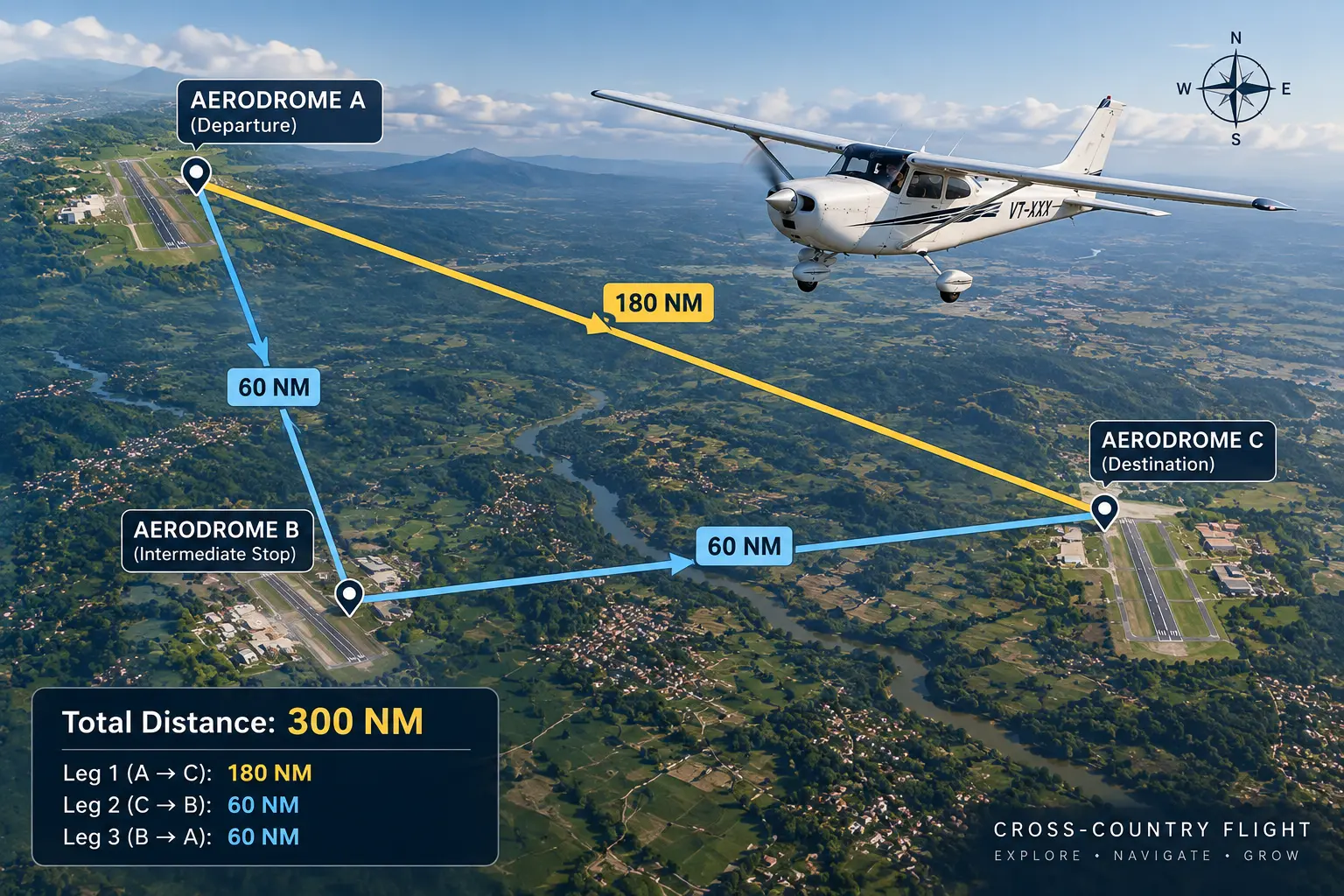
Most qualifying flights end up structured as a triangle or an out-and-back with a middle stop: depart, fly the long first leg past the 100 nautical mile mark to the first landing aerodrome, then a second leg to a different aerodrome, with the total of every leg adding to at least 300 nautical miles by the time you are back on the ground for good. The exact shape is a planning choice, not a fixed rule — what is fixed is the distance, the 100 nautical mile first leg, and the two-aerodrome landing condition.
Where cross-country sits inside the 200-hour total
It helps to see this component next to the other three, because the most common error students make with any single row of Schedule II is treating it as an addition to the total rather than a slice of it.
| Component | Hours | Clause | Note |
|---|---|---|---|
| Pilot-in-command | 100 | 1(e)(i) | of which not less than 15 hours in the six months before applying |
| Cross-country as PIC | 20 | 1(e)(ii) | including one flight of at least 300 nautical miles with full-stop landings at two different aerodromes |
| Instrument time | 10 | 1(e)(iii) | of which not more than 5 hours may be on an approved simulator |
| Night flying | 5 | 1(e)(iv) | including at least 10 take-offs and 10 landings as pilot-in-command |
20 hours is a modest fraction of 200, which is exactly why the single qualifying flight matters more than the raw hour count suggests — it is the one flight inside the whole syllabus that has to be planned as a specific event rather than logged incidentally during ordinary training.
How the flight is actually planned
Flying schools generally plan the route with margin above the 300 nautical mile floor rather than exactly at it, for the same reason a budget is planned above its minimum: wind, a routing change around controlled or restricted airspace, or a slightly longer taxi and departure sequence can all eat into a distance planned too tightly. A route padded by a reasonable margin survives an ordinary bad-wind day without falling short.
Aerodrome choice also depends on where you are training. A school based near a cluster of general aviation aerodromes has more route options within a comfortable day's flying than one training from a single base a long way from the next available airfield, and this is one of the practical differences worth asking about when comparing training programmes.
Mistakes that put the flight below the minimum
Almost every case of a flight falling short comes down to one of the same handful of causes, and all of them are avoidable with planning rather than luck on the day.
- Planning the route at exactly 300 nautical miles with no margin, so a headwind or a minor routing change on the day takes the actual flight below the minimum.
- Choosing a first leg that is close to the 100 nautical mile line rather than clearly past it, leaving no room for a navigational correction that shortens the leg as flown.
- Landing at only one aerodrome other than the departure point instead of two, usually because a return leg skips the planned intermediate stop.
- Treating the flight as one that can be flown dual, then discovering it needs to be logged as pilot-in-command time to satisfy the clause.
- Not confirming the diversion procedure with an instructor in advance, so an unplanned weather diversion turns into an argument about whether the flight still counts rather than a straightforward instructor decision made on the day.
What happens after you fly it
Once flown and correctly logged, the qualifying flight is recorded in your logbook against clause 1(e)(ii) the same way any other cross-country leg is, and it counts toward the 20-hour total alongside your other cross-country PIC time. There is no separate certificate or endorsement for it beyond the logbook entry itself and your instructor's sign-off — it is one line item inside the same 200-hour record that eventually supports your CPL application.
From there, training continues toward the rest of the 200 hours: the pilot-in-command time, the instrument time (with its own simulator cap, covered in our simulator hours guide), and the night flying component. None of those depend on the cross-country flight having been flown first, so schools sequence it wherever it fits their own syllabus and aircraft availability.
Ground classes at We One Aviation
We have taught the DGCA ground subjects from Dwarka since 2009, and questions about how the flying-hour requirements fit together — cross-country, instrument time, night flying, and the ground syllabus running alongside them — come up constantly from students planning their timeline before they commit to a flying school.
We teach the DGCA ground subjects and arrange flight training with partner flying schools. We do not own aircraft or simulators, we do not employ pilots, and we do not place students into airline jobs — hiring decisions rest with the operator.
People also ask
Does the 300 nautical mile cross-country flight have to be flown solo?
It has to be logged as pilot-in-command time, and at the stage of training where students fly it, that is normally solo — an instructor is not on board to log it as your PIC time otherwise. Confirm the exact arrangement your flying school follows, since syllabus sequencing (and any dual cross-country flights flown earlier for training) varies between schools even though the qualifying flight itself does not.
Can the rest of the 20 cross-country hours come from flights other than the 300 NM one?
Yes. The 300 nautical mile flight is one qualifying flight inside the 20-hour cross-country total, not the whole requirement by itself. The remaining hours are built up from other cross-country legs flown as pilot-in-command over the course of training.
Do the two landing aerodromes need to be a fixed distance apart from each other?
What Schedule II fixes is the total distance of the flight and the first leg reaching beyond 100 nautical miles from your departure point — not a minimum distance between the two landing aerodromes themselves. A flying school typically plans a route where the numbers work out comfortably rather than exactly at the minimum, so an unexpected headwind does not put the flight below 300 nautical miles.
What happens if weather forces a diversion during the qualifying flight?
A diversion away from the planned aerodromes means the flight, as flown, may no longer meet the two-aerodrome and distance conditions the rule sets out. Whether a particular diversion still counts is a call your flying school and instructor make against the actual track flown and logged — treat an unplanned diversion as a reason to check with them before assuming the flight qualifies, rather than assuming either way.
Does the cross-country flight also count toward night flying or instrument hours?
Not by default. Night flying and instrument time are separate components of the 200-hour total with their own conditions, and a daytime VFR cross-country flight satisfies only the cross-country requirement unless it is specifically flown to also meet one of those other conditions.
Can I fly the qualifying cross-country flight before finishing DGCA ground school?
The flight itself is a flying-training milestone, not a ground-school one, so schools commonly schedule it alongside ground classes rather than after them. Sequencing is set by your flying school’s own training programme, so confirm where it sits in your syllabus rather than assuming it waits until your written papers are cleared.
Related guides
- For how the simulator cap works on the instrument-time component of the same 200 hours, read our CPL simulator hours guide
- For the full licence ladder and how the 200-hour total fits the wider training path, see our complete guide to pilot training
- For how flying schools structure the whole CPL programme around this hour count, read our commercial pilot training programmes guide
- The full CPL flying and eligibility requirements are set out on the CPL course page
- For the DGCA ground subjects that run alongside your flying phase, see the DGCA ground classes page