Pilot training guide
What Is Pilot Training? Licences, PPL vs CPL and How Training Works in India (2027)
By We One Aviation Academy · Published · 12 min read
Last updated:
Quick Answer
What is pilot training?
Pilot training is the DGCA-regulated route to a pilot licence. For a commercial licence it means 5 written papers, the RTR (A) radio examination, a Class 1 medical and 200 hours of flying, measured against Schedule II of the Aircraft Rules, 1937. It is not a degree and not a job guarantee: it is the legal minimum to be paid to fly.
Key facts at a glance
- •Four licences, minimum ages SPL 16, PPL 17, CPL 18, ATPL 21 (Aircraft Rules, 1937, Schedule II).
- •5 DGCA written papers for a CPL, 70% in each; RTR (A) is separate.
- •200 hours of flying for a CPL, within 5 years of applying.
- •A PPL never permits paid flying and is not required before a CPL.
- •No regulation fixes the duration or the price of training.
- •Sources: Schedule II and DGCA CARs, read 2026-09-11 to 2026-09-17.
Type “pilot training” into a search bar and you get course packages, eighteen-month promises, salary screenshots and a dozen acronyms, often on the same page. It is hard to tell what is a rule and what is a sales line, and students regularly pay for things in the wrong order because of it. Pilot training in India is simpler than it looks once you see its shape: a ladder of four licences, two halves (ground and flying) that run side by side, and one regulator whose rules decide every step. This guide explains that shape in plain terms, so the rest of the decisions make sense.
What is pilot training?
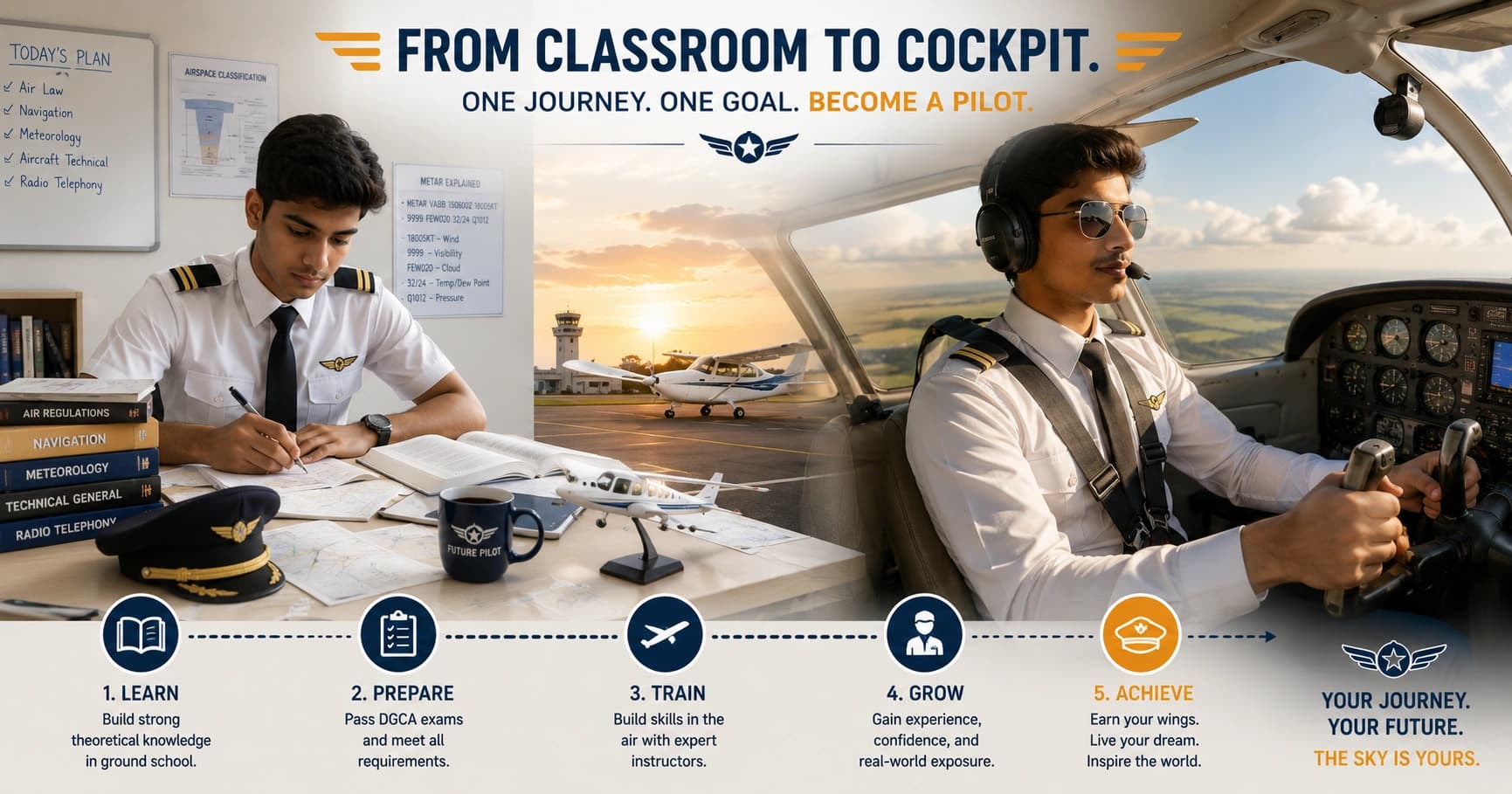
Pilot training is the regulated process of earning a pilot licence from the Directorate General of Civil Aviation. It has three parts that run in parallel: written examinations, medical fitness and logged flight time, each measured against Schedule II of the Aircraft Rules, 1937.
Three things pilot training is not. It is not a college degree: no university confers a pilot licence. It is not an admission with a cut-off and a merit list: the licence is issued to anyone who meets the rules. And it is not a job: a Commercial Pilot Licence is the legal minimum that lets an operator pay you to fly, and the operator still decides whether to hire you. The Aircraft Rules themselves, continued in force by the Bharatiya Vayuyan Adhiniyam, 2024, are on India Code.
Which pilot licences can you train for in India?
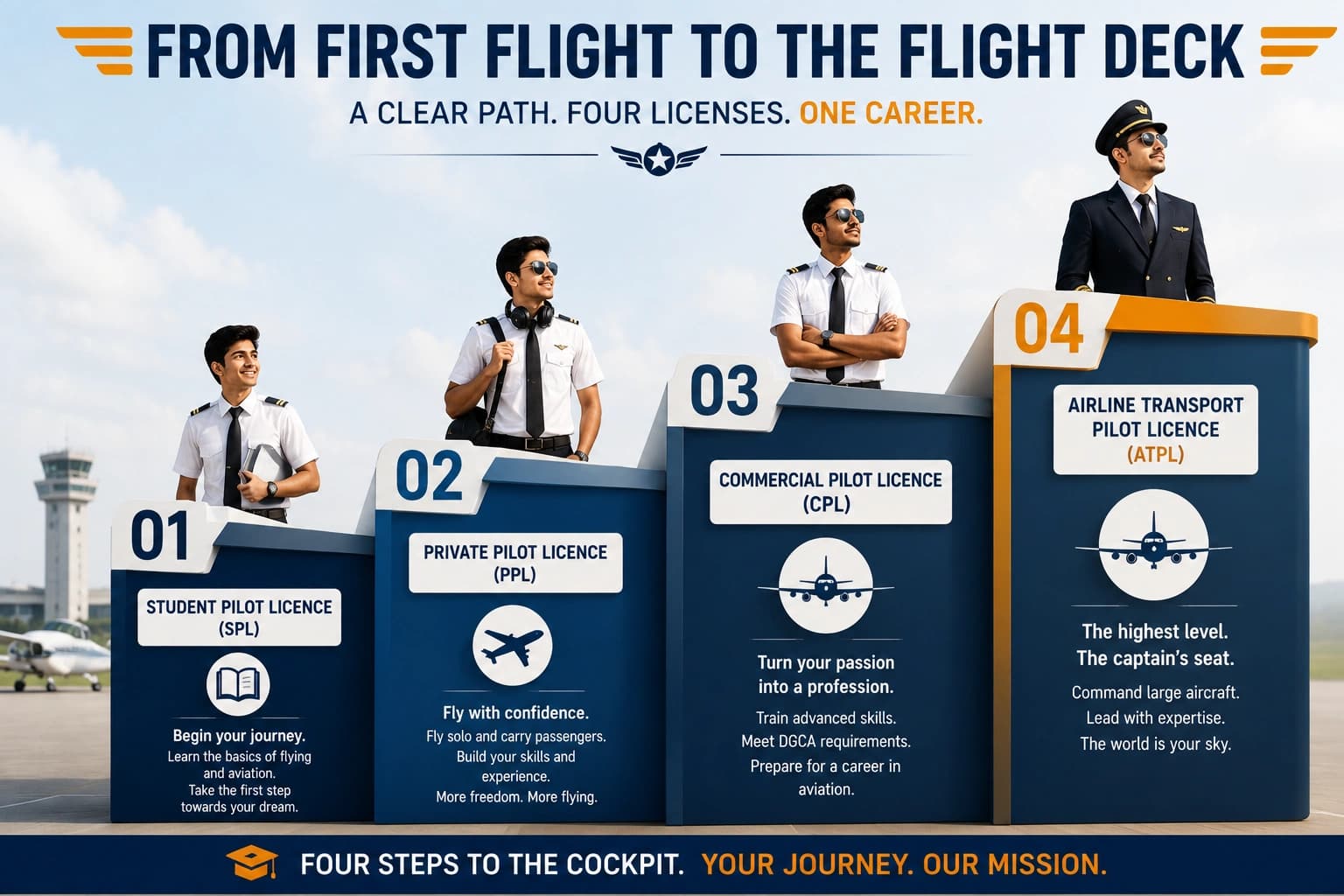
India has four aeroplane pilot licences, each in its own section of Schedule II and each with its own minimum age: the Student Pilot Licence, the Private Pilot Licence, the Commercial Pilot Licence and the Airline Transport Pilot Licence. Only the last two permit flying for payment.
| Licence | Minimum age | Schedule II | What it permits |
|---|---|---|---|
| SPL — Student Pilot Licence | 16 | Section B | Flight training, including solo flying under instructor authorisation. Never carrying passengers, never flying for payment. |
| PPL — Private Pilot Licence | 17 | Section E | Personal and recreational flying. Never flying for payment. |
| CPL — Commercial Pilot Licence | 18 | Section J | Flying for payment. Requires 200 hours of flight time. |
| ATPL — Airline Transport Pilot Licence | 21 | Section M | Acting as pilot-in-command of a commercial aeroplane. |
SPL means something different in the United States
In India, SPL is the Student Pilot Licence, the first rung, which permits flight training including solo flying under instructor authorisation. In the United States the same initials are used for a Sport Pilot certificate, a recreational category under a different regulator. A page describing an “SPL” with weight limits and day-only flying is describing the American certificate. Our Student Pilot Licence page covers the Indian one.
Should you train for a PPL or a CPL?
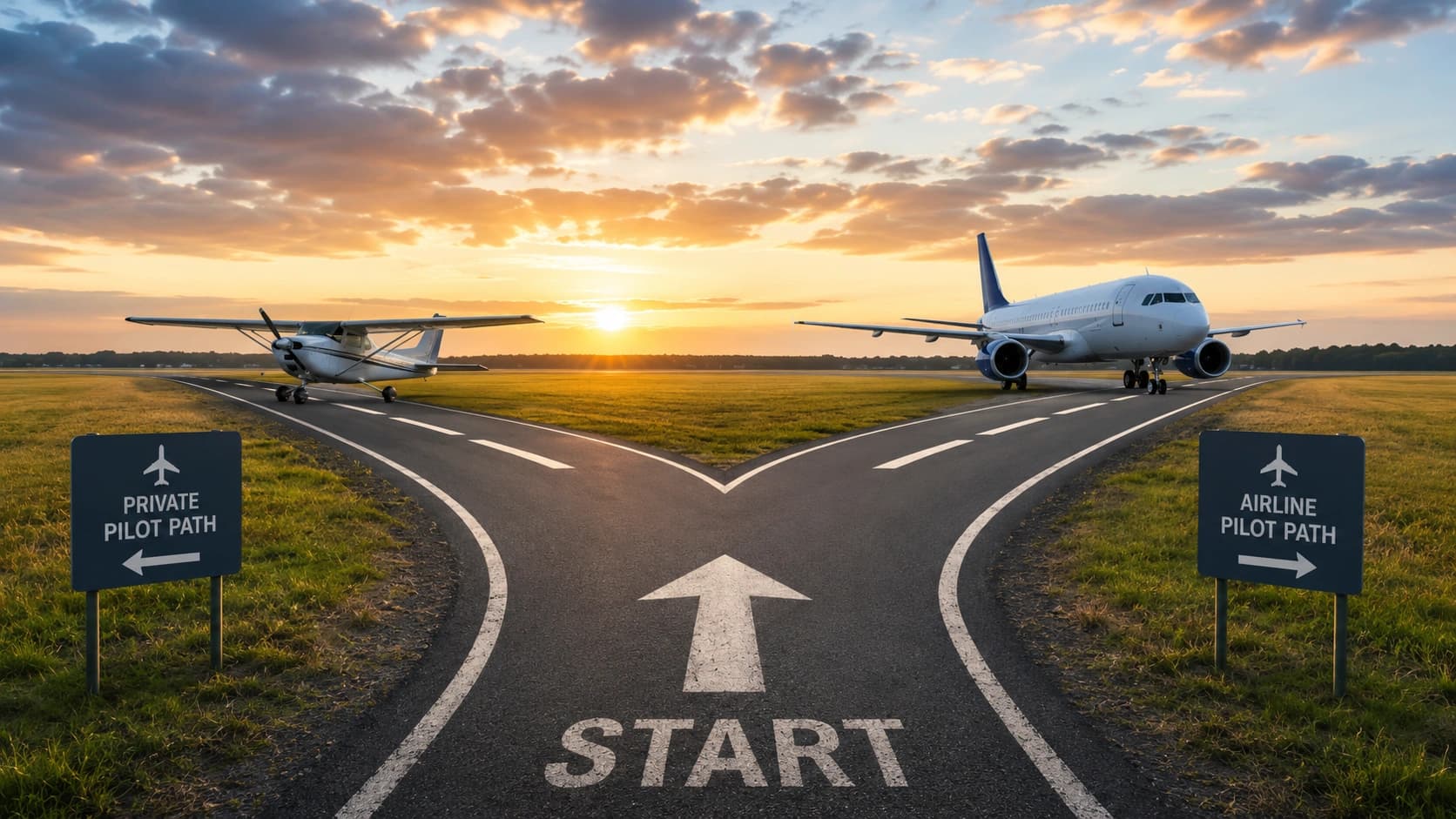
Train for a CPL if you want to be paid to fly, because a PPL never permits paid flying whatever hours you hold. A PPL suits someone flying for their own reasons; it is not a required step before the CPL.
| Point | PPL | CPL |
|---|---|---|
| Purpose | Personal and recreational flying | Flying for payment |
| Minimum age | 17 | 18 |
| Education (Pariksha) | Class 10 pass | Physics and Mathematics at 10+2 |
| Medical | Class 2 | Class 1 |
| Flying | Its own, lower requirement | 200 hours |
| Paid flying | Never | Yes, subject to ratings and the operator |
Hours flown before a CPL are flight time and count towards its total, so a PPL taken first is not wasted, but it is not required either. The question is answered in full in do you need a PPL before a CPL, and the PPL’s own subject rule in the PPL Physics and Maths post.
What are the ground half and the flying half of pilot training?
The ground half of pilot training is the 5 DGCA written papers plus the RTR (A) radio examination; the flying half is 200 hours of logged flight time at a flying training organisation. The two can run side by side, and most students start the papers before or alongside the flying.
The ground half
The papers are Air Navigation, Aviation Meteorology, Air Regulations, Technical General and Technical Specific, booked on the DGCA Pariksha portal with a computer number. Each needs 70% on its own, under the DGCA examinations CAR. Examined separately from the DGCA written papers, and required for CPL issue under Section J paragraph 1(g). How the examinations work, from fees to sessions, is in our DGCA exam guide.
The flying half
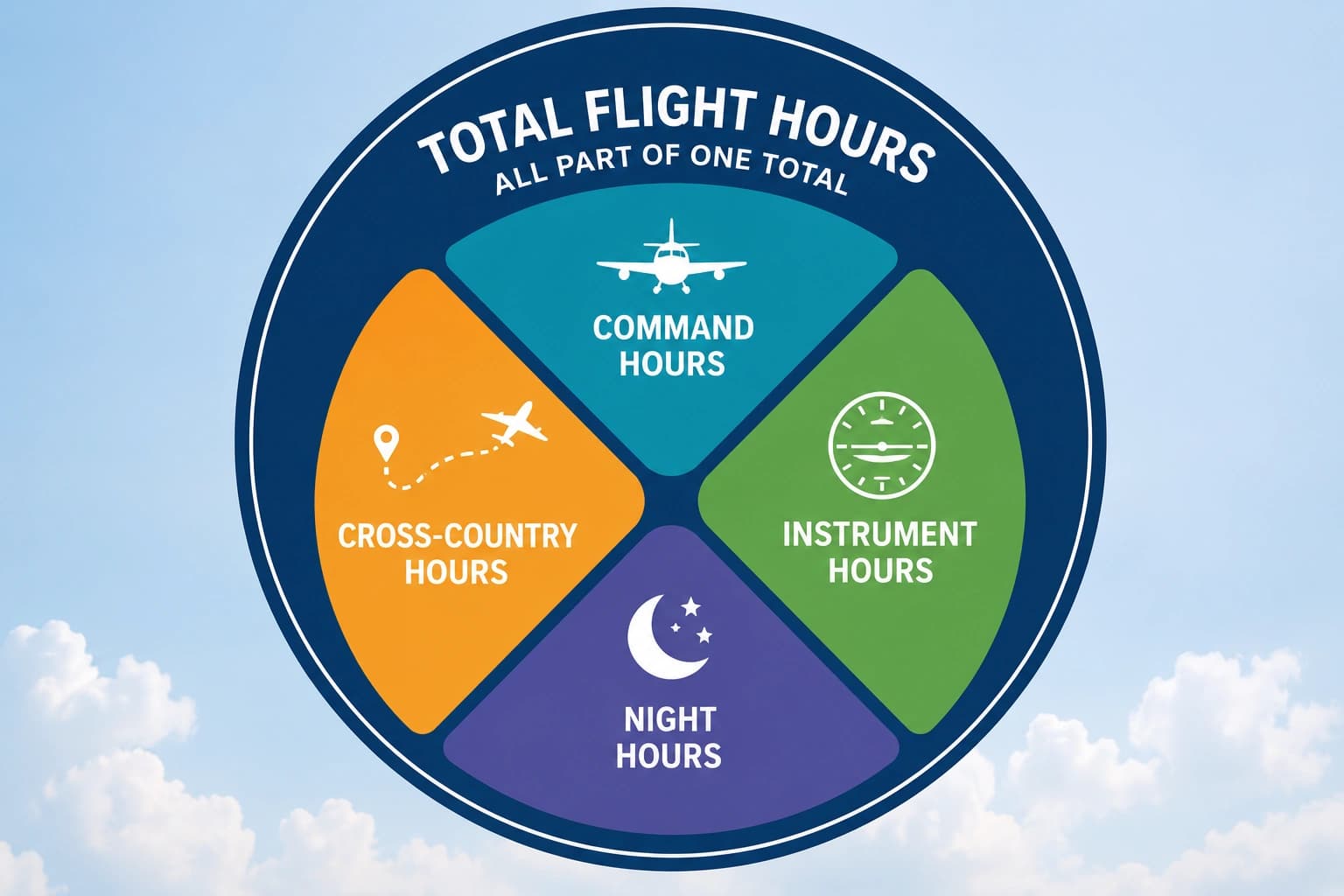
A CPL needs 200 hours of flight time, flown within the 5 years before applying. The components below sit inside that total; reading them as additions is the most common arithmetic mistake students make.
| Component | Hours | Condition |
|---|---|---|
| Pilot-in-command | 100 | of which not less than 15 hours in the six months before applying (1(e)(i)) |
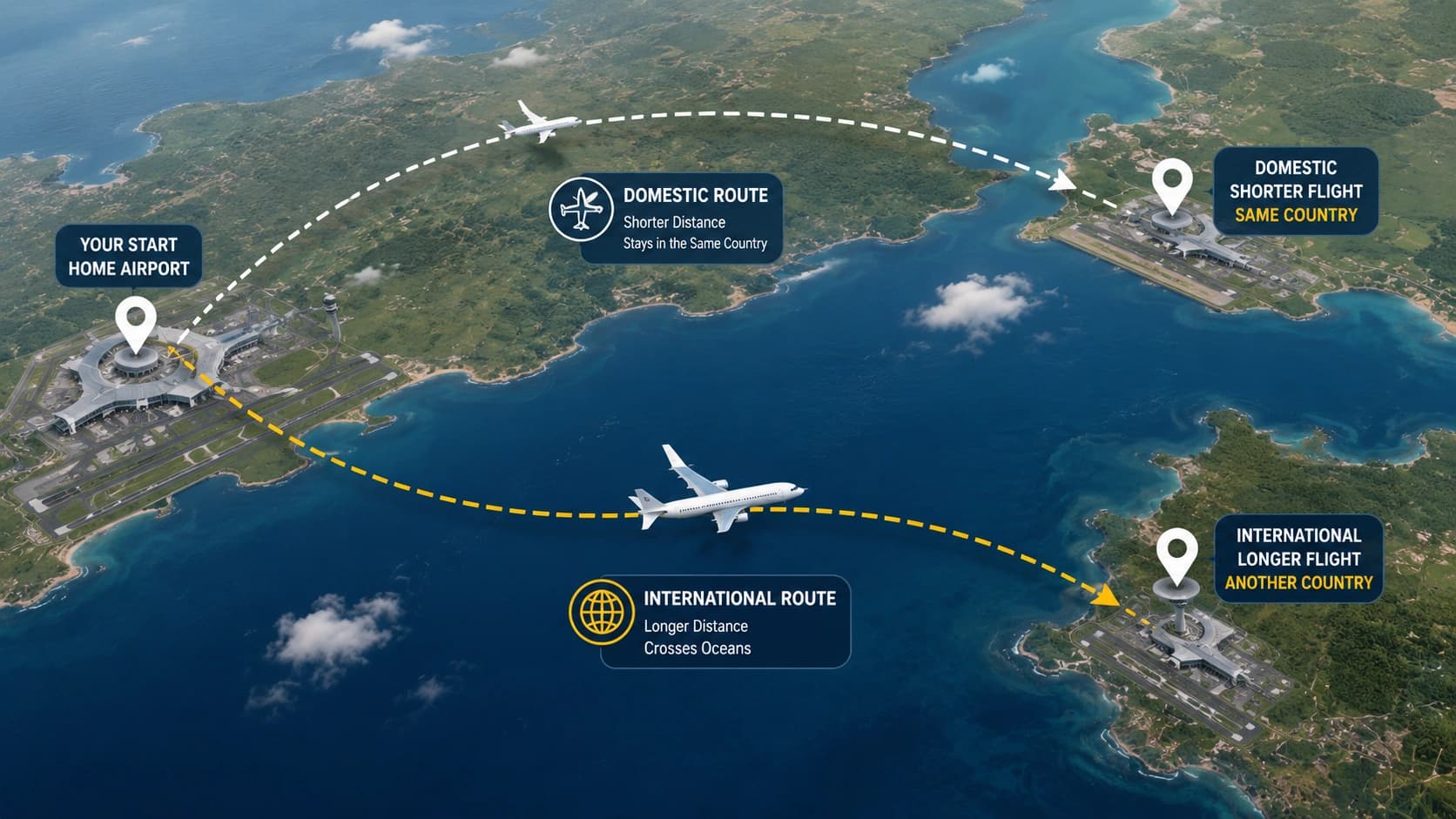
| Cross-country as PIC | 20 | including one flight of at least 300 nautical miles with full-stop landings at two different aerodromes (1(e)(ii)) |
| Instrument time | 10 | of which not more than 5 hours may be on an approved simulator (1(e)(iii)) |
| Night flying | 5 | including at least 10 take-offs and 10 landings as pilot-in-command (1(e)(iv)) |
Who is eligible for pilot training in India?
Anyone can begin pilot training, but the Commercial Pilot Licence is issued only to a candidate who is at least 18, has Physics and Mathematics at 10+2, holds a Class 1 medical, has passed the papers and the radio examination, and has logged the flying. Every requirement sits in Schedule II, Section J.
| Requirement | What the rule says | Clause |
|---|---|---|
| Minimum age | 18 years | Section J, para 1(a) |
| Education | Class 10+2 with Physics and Mathematics from a recognised Board or University | Section J, para 1(b) |
| Medical fitness | A Class 1 medical assessment from a DGCA-approved medical authority | Section J, para 1(c) |
| Written examinations | 5 DGCA papers, 70% in each | Section J, para 1(d) |
| Flying | 200 hours, within 5 years of applying | Section J, para 1(e) |
| Radio | RTR (A), examined separately | Section J, para 1(g) |
Students from a Biology or Commerce stream are not excluded: students from a Biology or Commerce stream clear both subjects as private candidates through NIOS and then apply. The medical comes first in practice. Book the Class 1 initial before committing money to a flying school. The student pilot licence only needs a Class 2, but the licence you are training towards needs a Class 1 — and finding a disqualifying condition after paying a deposit is an expensive way to learn it. The DGCA medical CAR sets the classes, and our Class 1 and Class 2 medical guide explains where each is done.
How long does pilot training take in India?
No regulation fixes how long pilot training takes, and any single figure is an estimate. The duration is set by four things: how quickly the papers are cleared, the flying school’s weather and aircraft availability, the medical, and, for students abroad, visas and the conversion steps on return.
- The papers. 5 papers, each passed on its own, in sessions DGCA schedules through the year.
- The flying. Hours are flown when the aircraft, an instructor and the weather all line up; ask a school how many days it lost to weather last year.
- The medical. A finding that needs investigation pauses everything that depends on it.
- The outer limit. For the issue of a CPL or an ATPL, that period is five years. Clearing papers years before you finish your flying hours is not free. Count backwards from the licence application, not forwards from the first paper.
What does pilot training cost in India?
No government body publishes a market price for pilot training in India, and private flying schools do not publish their fees. Two kinds of figure can be checked: DGCA’s own statutory charges, and the published course fee of IGRUA, a government academy.
Indira Gandhi Rashtriya Uran Akademi (IGRUA) (government flying academy under the ministry of civil aviation) publishes ₹55,00,000 for its ab-initio to CPL, fixed wing course. IGRUA states that no GST applies to this fee at present.
Included in the fee
- 465 hours of ground training across the DGCA subjects
- 20 hours on a single-engine cockpit procedure trainer and 20 hours on a twin-engine simulator
- 200 hours of flying, the figure the CPL requires
- Instrument Rating and multi-engine endorsement
Not included
- About ₹2,50,000 for uniform, study material, navigation computer and headphones
- DGCA and RTR examination and licence fees, paid by the trainee directly
- Hostel at ₹2,000 per person per month
- Messing at roughly ₹15,000 per month
- University and examination fees, where a candidate also enrols for the BSc
Source: IGRUA approved courses page, read 2026-09-11. Check the page for the current fee before relying on it.
Private flying schools in India do not publish their fees, and no government body publishes a market price, so the training-cost ranges circulating online cannot be traced to any document. What can be shown is DGCA’s own statutory charges and the one published course fee from a government academy. Our pilot training cost breakdown takes each line in turn, with the questions that expose an understated quote.
Should you train in India or abroad?
Neither is better in the abstract. Training in India keeps you inside the DGCA system with no conversion at the end; training abroad ends with that country’s licence, which then has to be converted to an Indian one before you can fly commercially here.
For a CPL, DGCA’s conversion CAR requires two written papers (Air Regulations and A composite paper for the Commercial Pilot Licence), a skill test in India, the Indian medical and the radio steps, and the foreign rating must be current. If the country that issued the licence requires fewer flying hours than Schedule II does, the shortfall has to be completed — either in the State that issued the licence, or in India. A licence issued at a lower hour requirement does not lower the Indian requirement. The comparison is set out in CPL training in India vs abroad and the conversion itself in converting a foreign licence.
What comes after the pilot licence?
After the licence comes the job search, and a CPL is not an appointment. Airlines, charter operators and flying schools each set their own requirements on top of the licence, and the Ministry of Civil Aviation has told Parliament that the shortage in India is of commanders, not of pilots in general.
“There is no shortage of Pilots/Crews in the Indian Aviation Sector. However, there is a shortage of commanders on certain types of aircraft.” (Ministry of Civil Aviation, PIB release of 2 August 2024, PIB.) Common first routes include airline first officer selection, flight instruction with an instructor rating, and charter flying. The airline route is set out in how to become an airline pilot in India, and the instructor route in the flying instructor rating guide.
Where to start
Start with the steps that rule things out cheaply. Book the Class 1 medical, apply for a DGCA computer number on Pariksha, and check your Class 12 subjects against the rule. Then start the papers and compare flying schools from DGCA’s own list. Done in that order, pilot training stops being a package you buy and becomes a set of steps you control.
We teach the DGCA ground subjects and arrange flight training with partner flying schools. We do not own aircraft or simulators, we do not employ pilots, and we do not place students into airline jobs — hiring decisions rest with the operator.
People also ask
What is pilot training?
Pilot training is the regulated process of earning a pilot licence from DGCA. For a commercial licence it combines 5 written papers, the RTR (A) radio examination, a Class 1 medical and 200 hours of logged flying, all measured against Schedule II of the Aircraft Rules, 1937.
What are the types of pilot licence in India?
India has four aeroplane pilot licences in a ladder: the Student Pilot Licence, the Private Pilot Licence, the Commercial Pilot Licence and the Airline Transport Pilot Licence. Their minimum ages are SPL 16, PPL 17, CPL 18, ATPL 21. Only the CPL and ATPL permit flying for payment.
What is the difference between a PPL and a CPL?
A Private Pilot Licence allows personal and recreational flying and never flying for payment; a Commercial Pilot Licence allows flying for payment. The PPL has a minimum age of 17 and needs a Class 2 medical; the CPL has a minimum age of 18, needs a Class 1 medical, 5 written papers and 200 hours of flying.
Do I need a PPL before a CPL in India?
No. A PPL is not a prerequisite for a CPL in India. Many students go straight from the Student Pilot Licence to CPL training, and any hours flown along the way count as flight time towards the CPL total.
Is pilot training a degree?
No. Pilot training leads to a licence issued by DGCA, not to an academic degree, and a degree does not replace any licence requirement. Some programmes run a degree alongside flying training, but the licence still depends on the papers, the medical and the flying hours.
Can I start pilot training before 18?
Yes. The minimum age of 18 applies to the issue of the Commercial Pilot Licence, not to training. The Student Pilot Licence is available from 16 and the DGCA computer number from 16, so many students start ground subjects while still in Class 12.
How long does pilot training take in India?
No regulation fixes how long pilot training takes. The duration depends on how quickly the 5 papers are cleared, flying-school weather and aircraft availability, and the medical. Papers passed for a CPL stay usable for five years, which is the outer limit to plan around.
Can I train abroad and fly in India?
Yes, but a foreign licence must be converted to an Indian one. For a CPL, DGCA's conversion CAR requires Air Regulations and A composite paper for the Commercial Pilot Licence, a skill test in India, an Indian medical and the radio licence steps, plus currency on the foreign rating.
Related guides
- The admission checklist, document by document, is in flight school prerequisites
- How to compare one CPL programme with another is covered in commercial pilot training programmes
- Whether to take the PPL first is answered in do you need a PPL before a CPL
- The clause-by-clause eligibility table is on the CPL eligibility page
- Training abroad against training at home is weighed in CPL training in India vs abroad
Primary sources
The documents this guide was checked against, last read 8 October 2026. They are published by the regulator or the government body named, and can change, so the document wins if it disagrees with this page.
- Aircraft Rules, 1937, Schedule II — Aircraft Personnel (India Code)
- Civil Aviation Requirement, Section 7, Series 'B', Part I, Rev. 2 dated 13 February 2019 — Eligibility criteria for examinations for issue of crew licences (DGCA)
- Flight Crew User Manual, Issue III Rev 0, October 2024 (DGCA Pariksha)
- There is no shortage of Pilots/Crews in the Indian Aviation Sector — PIB, 2 August 2024