Flight school admission
Flight School Prerequisites in India (2027): What to Have Ready Before Admission
By We One Aviation Academy · Published · 10 min read
Last updated:
Quick Answer
What do you need before joining a flight school in India?
Before joining a flight school in India you need Physics and Mathematics at 10+2 (for the CPL route), a DGCA Class 1 medical, a DGCA computer number from the Pariksha portal, and identity and education documents whose names and dates match exactly. Settle all four before paying a deposit; the CPL itself is issued from age 18.
Before you pay a deposit
- •Physics and Mathematics at 10+2 (Section J, para 1(b)); NIOS if they are missing.
- •Class 1 medical first; DGCA lists the Air Force centre fee at ₹5,000.
- •DGCA computer number on Pariksha, from age 16; immediate on DigiLocker, 15 working days manually.
- •Names and dates of birth must match across every document.
- •School on DGCA's list of 41 approved organisations, fee terms in writing.
- •Sources: Pariksha documents read 2026-09-11; DGCA medical CAR read 2026-09-17.
A flying school’s admission office will usually take a deposit long before anyone asks whether you have a medical, a computer number or documents that match. The money moves first, and the problems surface later: a colour-vision finding in month two, a computer number rejected because the Class 10 marksheet spells a name differently, a fee schedule nobody wrote down. None of that is unusual, and all of it is avoidable. This guide lists the flight school prerequisites in India in the order to complete them, with the rule behind each, so that by the time you pay a school you already know you can finish.
What are the prerequisites for flight school in India?
The prerequisites for flight school in India on the commercial route are Physics and Mathematics at 10+2, a DGCA Class 1 medical, a DGCA computer number and a consistent set of documents. Age matters for the licence rather than for admission: the CPL is issued from 18.
| Prerequisite | The rule | Set by |
|---|---|---|
| Age | Student Pilot Licence from 16; computer number from 16; CPL issued at 18 | Aircraft Rules, 1937, Schedule II; Pariksha FAQ |
| Class 12 subjects | Class 10+2 with Physics and Mathematics from a recognised Board or University | Schedule II, Section J, para 1(b) |
| Medical | Class 1 for the CPL; book the initial at a centre DGCA lists for initial issue | DGCA medical CAR |
| Computer number | Issued on the DGCA Pariksha portal; needed to sit any paper | Pariksha Flight Crew User Manual |
| Documents | Class 10 and 12 marksheets and certificates, ID and address proof, photographs, matching exactly | Pariksha User Manual and rejection list |
The full eligibility table, clause by clause, is on our CPL eligibility page.
In what order should you complete the prerequisites?
Complete the flight school prerequisites cheapest-disqualifier first: subjects, then the medical, then the computer number, then the papers and the school. Each early step can stop the route on its own and costs little, while the deposit at the end is the expensive commitment.
- Check your Class 12 subjects. Class 10+2 with Physics and Mathematics from a recognised Board or University. Students from a Biology or Commerce stream clear both subjects as private candidates through NIOS and then apply.
- Book the Class 1 initial medical. A Class 2 Medical Assessment is not a prerequisite for sitting the Class 1 initial examination. The CAR states the Class 2 assessment is issued for licensing purposes, Class 2 renewals, re-initials and temporary or permanent unfit cases. The fee DGCA lists at the Air Force centres is ₹5,000.
- Apply for the DGCA computer number. On Pariksha. On the manual route, the computer number is issued within 15 working days of submission of a complete application. On the DigiLocker route it is allotted immediately on successful submission.
- Start the DGCA ground subjects. 5 papers, 70% in each; they need no flying school and no medical to sit.
- Shortlist and verify flying schools. On DGCA's list of 41 approved organisations and its ranking.
- Agree written fee terms, then pay. Inclusions, extra-hour rate, payment schedule and refund conditions, in writing, before anything beyond a booking amount.
Which medical do you need before flight school, and when?
You need a DGCA Class 1 medical for a commercial licence, and it should be done before any money goes to a flying school. A Class 2 is enough for the Student Pilot Licence, but it is not a prerequisite for the Class 1, and the initial Class 1 can only be done at the centres DGCA lists for initial issue.
The Class 1 is valid one year up to the age of 60, and six-monthly thereafter. For single-crew operations, six-monthly above the age of 40. It is booked on eGCA, and the outcome is one of fit, fit with limitations, temporary unfit, permanent unfit. The DGCA medical CAR publishes no numeric eyesight figure; it adopts ICAO Annex 1 by reference, so treat any page quoting one with care. Our Class 1 and Class 2 medical guide lists the centres.
How do you get a DGCA computer number before admission?
A DGCA computer number is applied for on the Pariksha portal, from age 16, with no fee and no medical. On the DigiLocker route it is allotted immediately on successful submission; on the manual route it is issued within 15 working days of a complete application.
The two rules that cause most rejections
- Names. Names are entered exactly as they appear on the Class 10 marksheet or the passport, whichever was issued later. A spelling variation, a title, or a missing or extra middle name is a basic-detail mismatch and causes complete rejection.
- Date of birth. Only the Class 10 certificate and marksheet, or a birth certificate, are accepted as date-of-birth proof. An Aadhaar card is not accepted as the date-of-birth proof. The date must match the supporting document exactly, including the dd/mm/yyyy format. A difference of a single day causes rejection.
The DigiLocker route needs Indian nationality, both certificates in DigiLocker and an Aadhaar that matches exactly, as DGCA’s PIB release on auto-generation explains. Everyone else applies manually, usually with a Board Verification Certificate. The full process is in our computer number guide.
Which documents will you need for flight school admission?
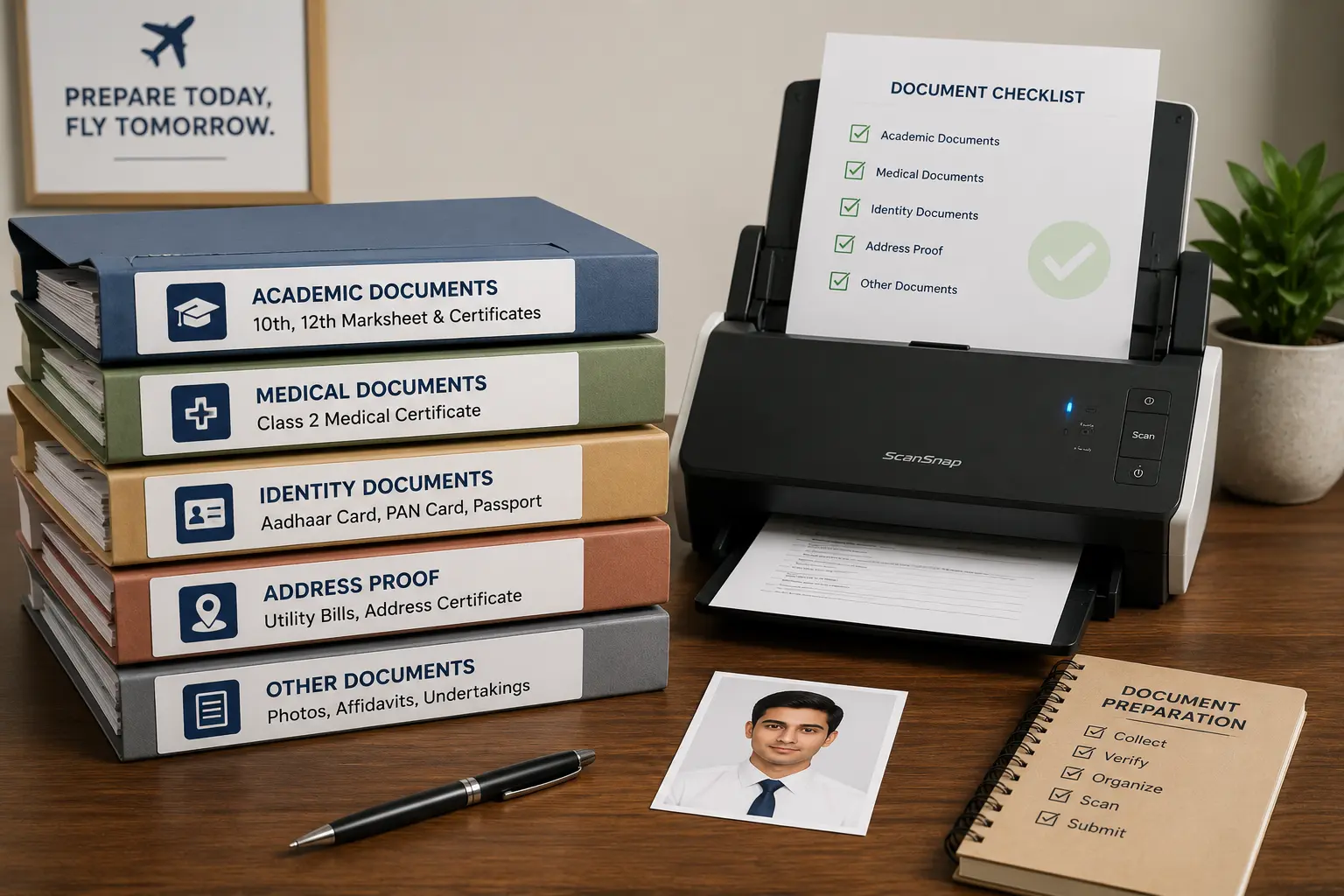
For flight school admission you will need your Class 10 and Class 12 marksheets and certificates, the medical assessment, the DGCA computer number, identity and address proof and photographs, and a passport if you train abroad. Each school sets its own list, but the Pariksha rules decide how the core documents must look.
| Document | Pariksha rule |
|---|---|
| Photograph | 45 mm high × 35 mm wide, white background, no border, colour only, matt finish; JPG/JPEG, up to 70 KB; not more than 3 months old |
| Signature | 20 mm high × 45 mm wide, white background, no border; JPG/JPEG, up to 20 KB |
| Class 10 and Class 12 marksheets and pass certificates | PDF, up to 500 KB |
| Date-of-birth certificate, Class 10 and Class 12 board verification certificates, 10+2 equivalence, address proof, university certificate, Aadhaar, security clearance, experience, FATA authorisation, other certificates | PDF, up to 100 KB |
| Logbook pages, passport, visa | PDF, up to 200 KB |
| Address proof | Aadhaar card, Passport, Voter ID, Licence issued by DGCA, Ration card, Address proof issued by a State or Central Government authority |
Both the marksheet and the pass certificate are needed for Class 10 and for Class 12. Where a board issues no separate pass certificate, the marksheet must itself read "Marksheet CUM Certificate". Nothing can be added after Final Submit. A forgotten document cannot be uploaded afterwards, and the photograph and signature cannot be replaced by the candidate later. These rules come from the Pariksha Flight Crew User Manual.
How do you check a flying school before admission?
Check a flying school before admission by finding it on DGCA’s list of approved flying training organisations (41 names as on 30 March 2026), reading its place in DGCA’s twice-yearly ranking, and getting its fee terms in writing. Delhi has no approved flying base on that list, so Delhi students train elsewhere.
Before any payment beyond a booking amount, get written answers to these:
- What is the hourly rate, and is it fixed for the length of the course?
- What happens if I need more than the hours in the quote — at what rate?
- Is the Instrument Rating included, or billed separately?
- Is the multi-engine endorsement included?
- Does the fee cover ground school, or is that a separate enrolment?
- Are accommodation and food inside the number or outside it?
- What is refundable, and on what notice, if I stop partway?
How to weigh the answers is in how to choose the best flying school in India. DGCA’s own examination fee, paid by you directly, is ₹2,500 per paper in a regular session.
Which admission mistakes cost students the most?
The admission mistakes that cost students the most are paying before the medical, leaving a document mismatch unresolved, and signing without written fee terms. Each is cheap to avoid and expensive to undo.
- Paying a flying school before the medical is done. The medical costs a fraction of a deposit and decides whether the rest is worth starting.
- Letting a name or date-of-birth mismatch sit unresolved. It causes complete rejection of the computer number application, and it surfaces again at licence issue.
- Accepting an approval certificate image as proof, instead of finding the school on DGCA’s own list.
- Signing without written fee terms, a milestone-linked payment schedule and refund conditions.
- Choosing on the headline quote alone. A lower figure with the Instrument Rating billed separately is not a lower figure.
- Clearing papers years ahead of the flying without counting the five-year window back from the licence application.
Your pre-deposit checklist
If you can tick every line below, you are ready to pay a flying school; if you cannot, the unticked line is your next step.
- Physics and Mathematics at 10+2 confirmed, or the NIOS route under way.
- Class 1 initial medical done, with the CA-35 in hand.
- DGCA computer number allotted, with names and dates matching every document.
- The school found on DGCA’s list, and its ranking read.
- Fee terms, extra-hour rate and refund conditions in writing.
We teach the DGCA ground subjects and arrange flight training with partner flying schools. We do not own aircraft or simulators, we do not employ pilots, and we do not place students into airline jobs — hiring decisions rest with the operator.
People also ask
What are the prerequisites for flight school in India?
The prerequisites for flight school in India are Physics and Mathematics at 10+2 for a CPL route, a DGCA medical (Class 1 for a CPL), a DGCA computer number from the Pariksha portal, and matching identity and education documents. The CPL itself is issued from age 18; training can start earlier.
Is there an upper age limit for pilot training in India?
Schedule II sets minimum ages for pilot licences, not maximum ones, and the Pariksha FAQ states that no maximum age is prescribed for the computer number. Medical fitness applies at every age, and the Class 1 renewal interval shortens after 60. Airline cadet programmes set their own upper limits.
Do I need a DGCA computer number before joining a flying school?
A DGCA computer number is needed to sit the written papers, and many flying schools ask for it at admission. It costs nothing to apply for, needs no medical, and can be applied for from age 16, so it is sensible to have it before choosing a school.
Which documents does a flying school need for admission?
Flying schools generally ask for Class 10 and Class 12 marksheets and certificates, the medical assessment, the DGCA computer number, identity and address proof, photographs and, for training abroad, a passport. Requirements vary by school, so ask for its list in writing. The names and dates must match across every document.
Can I begin ground school before my computer number arrives?
Yes. The DGCA computer number is required to sit an examination, not to study for one. Starting ground classes while the application is processed uses the waiting time, and on the DigiLocker route the number is allotted immediately anyway.
Do passed DGCA papers expire?
Yes. Theoretical knowledge papers must be completed within two and a half years immediately preceding the date of application. For the issue of a CPL or an ATPL, that period is five years. The period is counted back from the date of the licence application.
What happens if the medical finds a problem?
The DGCA medical has four outcomes: Fit, Fit with limitations, Temporary unfit, Permanent unfit. Some findings need investigation before a decision. A licence holder declared unfit for more than three months, or permanently, may appeal within 90 days. Only the examining authority can say which applies to you.
How many flying schools should I apply to?
Shortlist three or four flying schools and verify each one properly, rather than applying widely and comparing brochures. Check each on DGCA’s approved list and ranking, ask for average hours to licence and completion records, and get fee terms in writing before choosing.
Related guides
- The computer number, route by route, is in our DGCA computer number guide
- The mistakes that get an application rejected are listed in why computer number applications get rejected
- The certificate many boards issue for Pariksha is explained in the Board Verification Certificate
- How to compare programmes once you are ready is in commercial pilot training programmes
- Where each medical is done is on the Class 1 and Class 2 medical page
Primary sources
The documents this guide was checked against, last read 8 October 2026. They are published by the regulator or the government body named, and can change, so the document wins if it disagrees with this page.
- Flight Crew User Manual, Issue III Rev 0, October 2024 (DGCA Pariksha)
- Flight Crew Computer Number Registration — FAQ (DGCA Pariksha)
- Reasons for rejection of computer number applications (DGCA Pariksha)
- DGCA begins auto-generation of computer numbers for flight crew through Pariksha (PIB, 17 October 2025)
- CAR Section 7, Series 'C', Part I, Issue II 12 October 2017, Rev. 7 dated 01 October 2025, effective 15 November 2025 — Medical Requirements and Examination for Flight Crew / Air Traffic Controller Licences and Ratings
- List of DGCA Approved Flying Training Organisations (as on 30.03.2026) — DGCA