Licensing
How to Convert a Foreign Pilot Licence to an Indian DGCA Licence
By We One Aviation Academy · Published · 9 min read
Last updated:
Quick Answer
How do I convert a foreign pilot licence to a DGCA licence?
A licence issued by another country’s regulator is that country’s licence. It does not permit commercial flying on an Indian-registered aircraft. To fly commercially in India you apply to DGCA for an Indian licence on the basis of the foreign one, and that application has its own requirements. You must meet DGCA's age, education, medical and flying-experience requirements under Schedule II, clear two written papers (Air Regulations and a composite Navigation/Meteorology paper for a CPL), pass a skill test with a DGCA-approved examiner in India, and separately obtain an Indian RTR(A). Ratings not current in the last 24 months need an additional technical exam and endorsement training.
The conversion, in five lines
- •A foreign licence is that country’s licence — it does not permit commercial flying on an Indian-registered aircraft
- •Two written papers for a CPL conversion, not the full five-paper Indian set
- •An ATPL conversion adds an oral examination to its two written papers
- •The foreign rating must be current — 10 hours as PIC in 24 months, or a recent check — or you sit an extra technical exam and endorsement training
- •RTR(A) is a separate certificate from a different ministry, and it is the step most guides leave out
Why a foreign licence needs converting at all
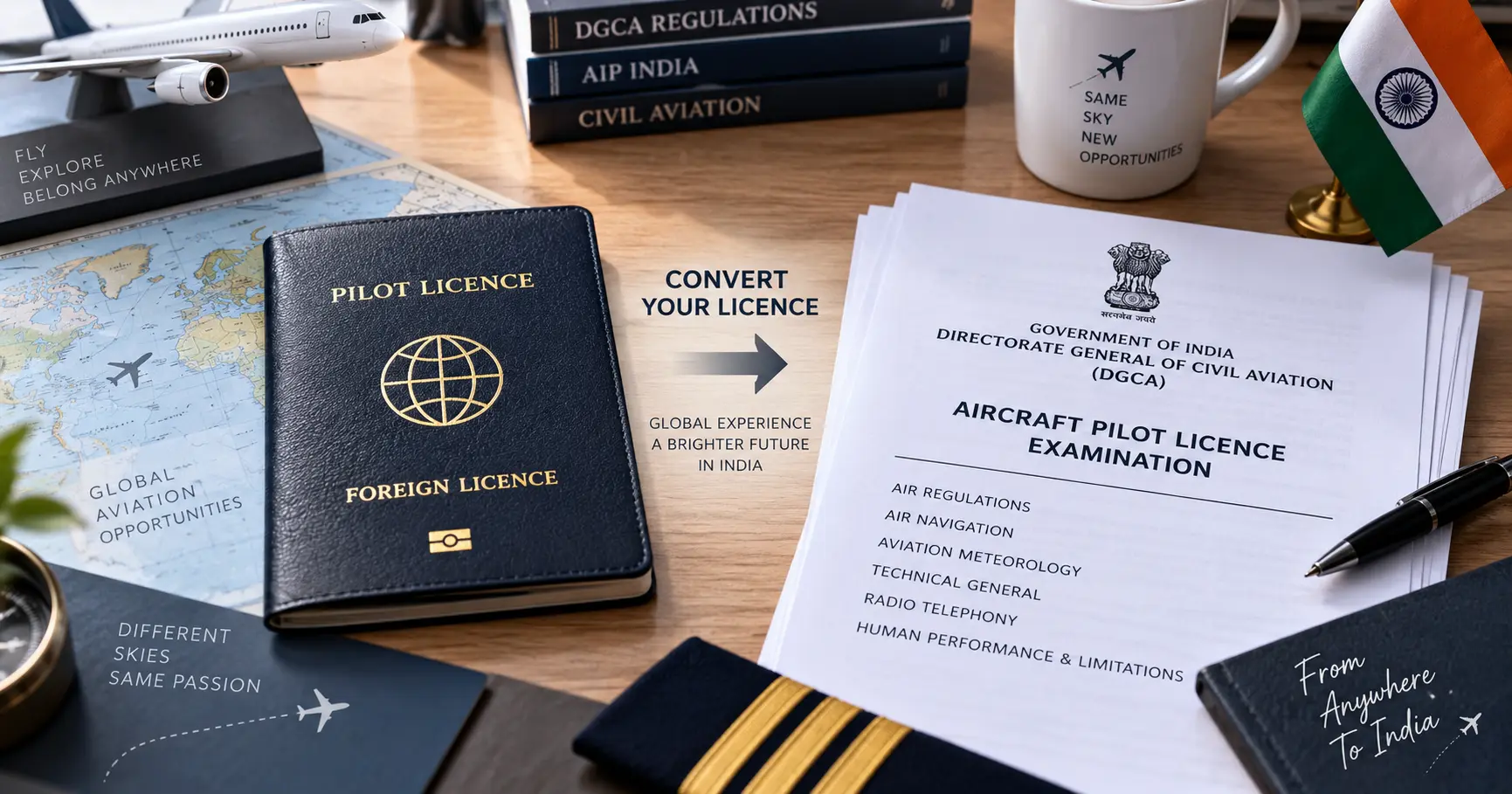
A licence issued by another country’s regulator is that country’s licence. It does not permit commercial flying on an Indian-registered aircraft. To fly commercially in India you apply to DGCA for an Indian licence on the basis of the foreign one, and that application has its own requirements. That single sentence, from Civil Aviation Requirement, Section 7 — Flight Crew Standards, Training and Licensing, Series 'G', Part I, Issue II dated 01 July 2019, Revision 4 dated 9 September 2019, is the whole reason this page exists. A student who trains in the United States, Canada, Australia, South Africa or Sri Lanka and comes home with a foreign Commercial Pilot Licence has not finished the India side of the process — they have started a second, shorter one.
DGCA does not treat every foreign licence identically either. The requirement is issued under Rules 41 and 133A of the Aircraft Rules, 1937., and it applies specifically to pilots holding licences and ratings issued by a Contracting State — a country that is party to the Chicago Convention and whose licensing DGCA accepts as meeting ICAO standards. Read from a PDF of the DGCA-issued document. Check DGCA's CAR index for a revision later than Rev. 4 before relying on it.
The four general requirements
Before DGCA looks at a single paper or a single flying hour, four things have to be true, and they are the same four that apply to a candidate trained entirely in India.
| Area | What DGCA requires |
|---|---|
| Age | Age, as laid down in the relevant section of Schedule II of the Aircraft Rules, 1937 |
| Education | Educational qualifications, as laid down in Schedule II — Class 10+2 with Physics and Mathematics from a recognised Board or University |
| Medical | Medical fitness — the Indian medical assessment of the appropriate class. DGCA-mandated medical fitness assessment |
| Flying experience | Flying experience and competency, as laid down in Schedule II If the country that issued the licence requires fewer flying hours than Schedule II does, the shortfall has to be completed — either in the State that issued the licence, or in India. A licence issued at a lower hour requirement does not lower the Indian requirement. |
The experience row catches families off guard the most. A course sold abroad against that country’s own minimum hours does not lower what Schedule II asks for in India — the shortfall gets flown, in the issuing country or in India, before conversion can proceed.
The written papers, by licence
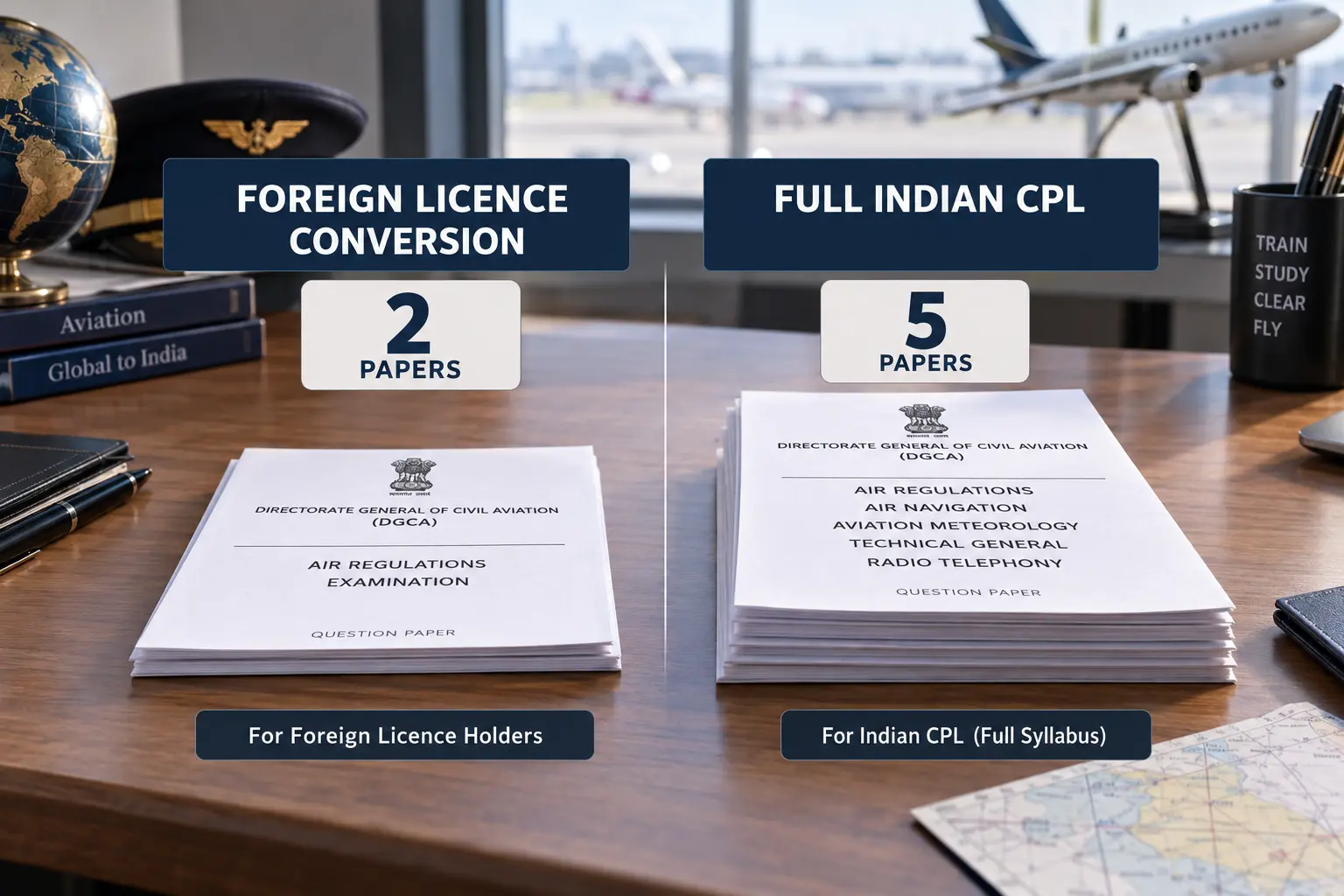
This is the part every conversion guide gets wrong by omission: a converting candidate does not sit the same paper set as someone trained in India from the start. The Indian CPL route means 5 subjects. Conversion means two, for a CPL.
| Licence | Papers with CEO | Note |
|---|---|---|
| Commercial Pilot Licence (aeroplane or helicopter) | Air Regulations; A composite paper for the Commercial Pilot Licence covering Air Navigation and Aviation Meteorology | Two written papers with the Central Examination Organisation — not the full Indian CPL paper set. |
| Airline Transport Pilot Licence (aeroplane or helicopter) | Air Regulations; A composite paper for the Airline Transport Pilot Licence covering Air Navigation, Avionics (radio aids and instruments) and Aviation Meteorology | Plus an oral examination as stipulated in Schedule II, Section M or Section N, as the case may be. |
| Private Pilot Licence, microlight, glider, balloon, light sport aircraft and gyroplane licences | The examinations prescribed in the relevant section of Schedule II | The full set for that licence, not a reduced conversion set. |
A Private Pilot, microlight, glider, balloon, light sport aircraft or gyroplane conversion is different again — the full examination set laid down for that licence in Schedule II applies, with no reduced conversion paper. The applicant demonstrates competency in a skill test on the type of aircraft the application relates to, to the satisfaction of a DGCA-approved examiner in India.
The currency test on your foreign rating
The rating on the foreign licence has to be current for the type the conversion application relates to. DGCA does not take the rating’s face validity on trust — it asks whether you have actually been flying it recently, and where that flying has to have happened matters as much as how much of it there was.
| If your rating is… | What that means |
|---|---|
| Rating is current | At least 10 hours as pilot-in-command in the 24 months before the date of application — fifty per cent of co-pilot or dual time may be counted towards those 10 hours Or Or a flight review, check ride, flight test or skill test on the type in the same 24 months |
| Rating is not current | Pass the DGCA Technical Specific examination on the type, then Undergo endorsement training on the type, followed by skill tests |
That flying or that check has to be done in the State that issued the foreign licence.
Students who finish a foreign course and then spend a year clearing conversion papers before applying sometimes discover their currency window has closed in the meantime. Plan the conversion timeline around this rule, not around when the papers happen to get cleared.
The skill test and rating endorsement
The applicant demonstrates competency in a skill test on the type of aircraft the application relates to, to the satisfaction of a DGCA-approved examiner in India. Only current ratings are considered for conversion, and the aircraft type has to be registered in India. Competency is demonstrated in skill tests by day and by night before a DGCA-approved examiner in India.
For an aircraft above 5,700 kg all-up weight the instrument rating skill test is carried out in India on forms CA40 and CA41; at or below 5,700 kg, on the instrument rating check proforma for that weight.
A current flying instructor rating from a Contracting State can carry across too, into an Assistant Flight Instructor or Flight Instructor rating on the Indian licence — subject to the experience Schedule II sets for that rating and a competency check before a DGCA-approved examiner or Flight Operations Inspector within the six months before applying.
RTR(A): the step people forget
This is the step people forget. The radio certificate comes from a different ministry, on its own timetable, and a commercial or airline transport conversion cannot complete without it.
- A Certificate of Proficiency from the Ministry of Communications, under the Indian Wireless and Telegraphy Rules, 1954, for operating radio telephony apparatus on board an aircraft
- On that basis, DGCA issues a Flight Radio Telephone Operator licence under Section ‘Y’ of Schedule II
- A Signals (Practical) examination for the interpretation of signals, to the prescribed syllabus
Examined separately from the DGCA written papers, and required for CPL issue under Section J paragraph 1(g). A candidate who already holds a foreign radio operator qualification still goes through this Indian route — the two are issued by different regulators and one does not stand in for the other.
A realistic sequence
Nothing here is a fixed DGCA timetable — the CAR does not mandate an order — but the dependencies between the pieces point to a sensible one: confirm your rating is current, or plan for the endorsement route if it is not; register on eGCA and book the two written papers; book the Indian medical assessment early, since a disqualifying finding is cheaper to learn about before the rest is arranged; start the Certificate of Proficiency application for RTR(A) in parallel, since it runs on its own timetable at a different ministry; and schedule the skill test only once the papers and the medical are both in hand, since a DGCA-approved examiner is checking a candidate who is otherwise ready to hold the licence.
Verification, and what false documents cost you
DGCA may verify the authenticity and validity of the documents with the aeronautical authority of the issuing State and with the training institute where the training was done.
A licence or rating obtained on incorrect information or false documents is liable to be cancelled, and the applicant is subject to action under the Aircraft Act, 1934, the Aircraft Rules, 1937 and the Indian Penal Code, 1860. The foreign licensing authority may be informed.
The application goes to DGCA, marked for the attention of the Director, Training and Licensing, with the documents required under Schedule II and this CAR. Fees are those prescribed in Rule 48 of the Aircraft Rules, 1937. We do not publish a figure here because we have not read the current schedule.
Ground classes at We One Aviation
We teach the DGCA ground subjects from Dwarka, and the two conversion papers — Air Regulations and the composite Navigation/Meteorology paper — sit inside the same syllabus we teach a candidate training in India from the start. A student returning from a foreign course does not need to repeat everything they already studied abroad; they need focused preparation for the specific papers DGCA sets for a conversion, and a clear view of the RTR(A) and medical steps that run alongside it.
We teach the DGCA ground subjects and arrange flight training with partner flying schools. We do not own aircraft or simulators, we do not employ pilots, and we do not place students into airline jobs — hiring decisions rest with the operator.
People also ask
Can I fly commercially in India on my foreign pilot licence?
No. A licence issued by another country’s regulator is that country’s licence. It does not permit commercial flying on an Indian-registered aircraft. To fly commercially in India you apply to DGCA for an Indian licence on the basis of the foreign one, and that application has its own requirements.
How many DGCA papers do I need to clear to convert a foreign CPL?
Two — Air Regulations and a composite paper covering Air Navigation and Aviation Meteorology — not the full 5-paper set an Indian-trained CPL candidate sits. An ATPL conversion adds an oral examination on top of its two written papers.
What happens if my foreign rating is not current?
Pass the DGCA Technical Specific examination on the type, then Undergo endorsement training on the type, followed by skill tests. Both in India, and both before the conversion application is made.
Do I need an Indian RTR(A) if I already hold a foreign radio licence?
Yes. This is the step people forget. The radio certificate comes from a different ministry, on its own timetable, and a commercial or airline transport conversion cannot complete without it.
Is it cheaper to train abroad and convert, or train in India from the start?
Nobody can give you a sourced total for either path — see our pilot training cost guide for why the market figures in circulation cannot be traced to a published document. What can be shown is the extra steps a conversion adds: two written papers, a skill test, RTR(A), and the Indian medical, all after the foreign course is already paid for.
Can DGCA refuse to convert my foreign licence?
Yes. DGCA may verify the authenticity and validity of the documents with the aeronautical authority of the issuing State and with the training institute where the training was done. A licence or rating obtained on incorrect information or false documents is liable to be cancelled, and the applicant is subject to action under the Aircraft Act, 1934, the Aircraft Rules, 1937 and the Indian Penal Code, 1860. The foreign licensing authority may be informed.
Related guides
- For how a Commercial and an Airline Transport licence actually differ, see our CPL vs ATPL guide
- For what training costs in India, and why the abroad comparisons rarely trace to a source, read the pilot training cost breakdown
- The Level 4 English requirement referenced in a CPL application is covered in our English Language Proficiency guide
- For the licence itself once your papers and skill test are behind you, see the Commercial Pilot Licence course page
- The six-month ground syllabus that prepares you for the two conversion papers is on the DGCA ground classes page