
Pilot eligibility
English Language Proficiency (ELP) Test for Pilots in India: What DGCA's Level 4 Requirement Means
By We One Aviation Academy · Published · 8 min read
Last updated:
Quick Answer
What is the DGCA English Language Proficiency requirement for pilots?
DGCA requires every Commercial Pilot Licence applicant to hold English Language Proficiency at ICAO Level 4 (Operational) or above before the licence application can move forward. It is tested separately from the five written papers and from RTR (A), through a DGCA-recognised Aviation English Language Proficiency training and testing organisation — one of the final gates before licence issue.
ELP, in one view
- •Have cleared the English Language Proficiency examination at Level 4 or above — one of six prerequisites DGCA's own eGCA user manual lists before a CPL application moves
- •Tested separately from the 5 DGCA written papers and separately from RTR (A)
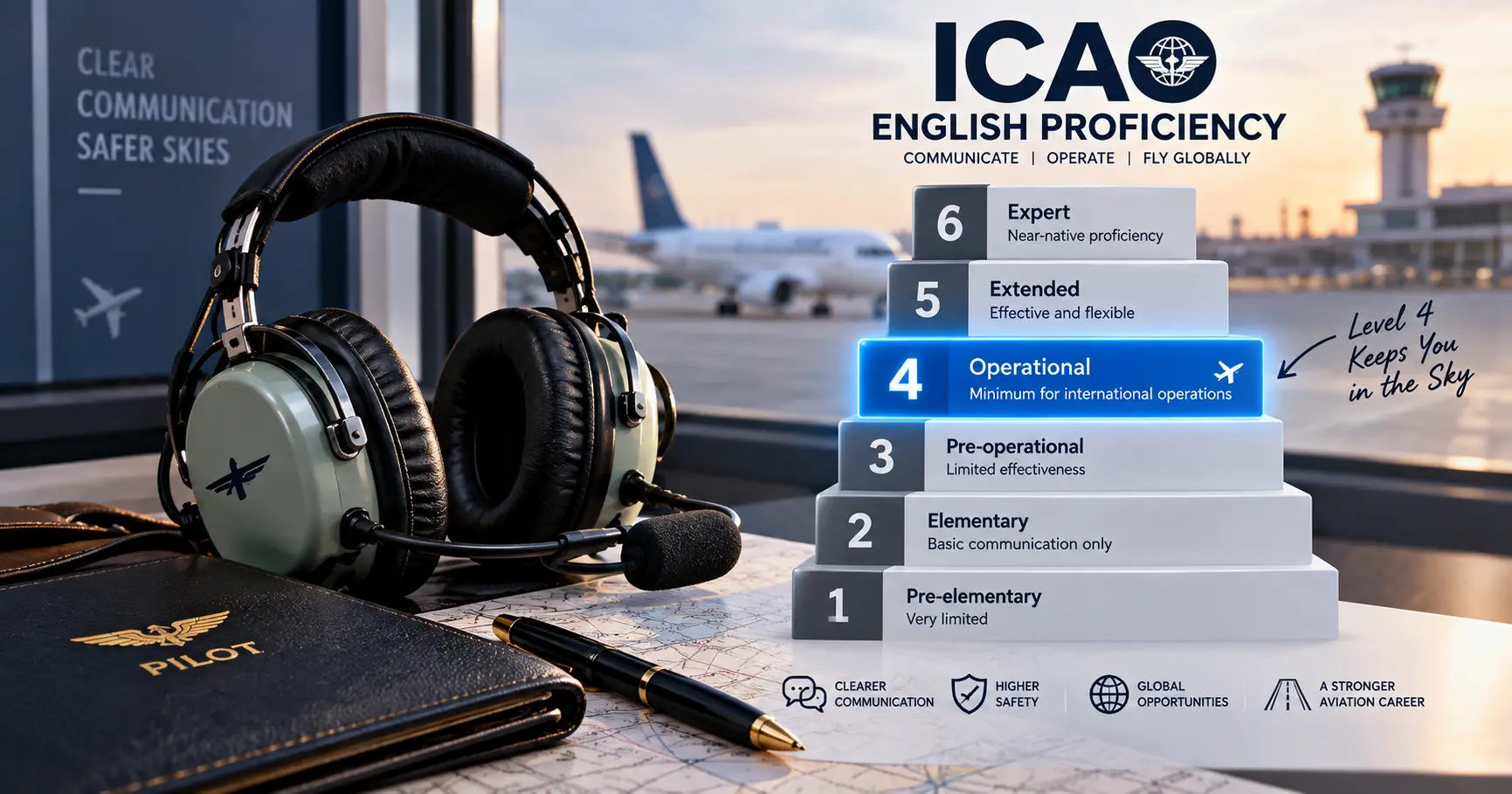
- •ICAO’s scale runs Level 1 (Pre-elementary) to Level 6 (Expert) across six descriptors — Level 4 is the regulatory floor, not a target to coast on
- •Only a DGCA-recognised Aviation English Language Proficiency (AELP) training and testing organisation may conduct the assessment
- •Level 6 does not need periodic reassessment; the exact reassessment interval below that could not be confirmed from a document this site could retrieve
- •Do not confuse it with RTR (A) — different standard, different governing instrument, different body
What is the DGCA English Language Proficiency requirement?
It is a spoken assessment of how well you can communicate in English in an operational, aviation context, and DGCA will not issue a Commercial Pilot Licence without a result at Level 4 or above on file. The requirement is stated plainly in DGCA’s own eGCA user manual for the CPL application: have cleared the english language proficiency examination at level 4 or above. It is easy to miss, because it never appears alongside the five written papers or the flying-hour requirement in most eligibility checklists — it sits quietly in the licence-issue paperwork instead, which is exactly why students discover it late.
The standard behind it is not a DGCA invention. It comes from the International Civil Aviation Organization’s Language Proficiency Rating Scale, published in Annex 1 to the Chicago Convention and detailed further in Doc 9835. Every country that licenses pilots and controllers for international operations implements some version of this scale; DGCA does so for India through Civil Aviation Requirement Section 7, Series ‘G’, Part III.
The ICAO six-level scale, and where Level 4 sits
The scale runs from Level 1 to Level 6, scored across six separate descriptors — pronunciation, structure, vocabulary, fluency, comprehension and interaction — and your lowest single descriptor score sets your overall rating. That last detail catches people out: being excellent on five descriptors and weak on one still produces the weak result.
| Level | Name | Meets DGCA’s minimum? |
|---|---|---|
| 1 | Pre-elementary | No |
| 2 | Elementary | No |
| 3 | Pre-operational | No |
| 4 | Operational | Yes — the regulatory floor |
| 5 | Extended | Yes |
| 6 | Expert | Yes — no periodic reassessment needed |
Levels 1 to 3 fall below what any licence needs and simply mean more training before a retest. Level 4, Operational, is the floor DGCA sets for licence issue — not a comfortable margin above it. A candidate who scrapes a 4 on every descriptor has met the rule exactly as written, which is one reason experienced examiners advise treating Level 4 as the minimum to clear rather than the standard to aim for.
Where ELP fits among the other CPL gates
DGCA’s eGCA user manual for submitting a Commercial Pilot Licence application lists six things that all have to be true before the application will go through. ELP is one line among six, not a separate hurdle bolted on afterwards.
| # | Prerequisite, from DGCA’s eGCA user manual |
|---|---|
| 1 | Be registered on the eGCA portal with your own eGCA ID |
| 2 | Hold a valid Class 1 medical certificate and the medical assessment sheet |
| 3 | Hold a valid FRTOL or FRTOL(R) with the RTR certificate |
| 4 | Have the e-logbook updated and e-validated by your flying training organisation for flying hours and skill tests |
| 5 | Have cleared the English Language Proficiency examination at Level 4 or above ← this page |
| 6 | Have passed the written examinations conducted by the Central Examination Organisation |
Notice what surrounds it: a valid Class 1 medical, a valid FRTOL with the RTR certificate, a validated e-logbook, and passes in the written examinations. ELP is not tested earlier or later than these as a matter of DGCA rule — it simply has to be done, on your own schedule, before the application is submitted. Most students clear it alongside the written papers rather than waiting for the flying phase to finish.
How the DGCA ELP test actually works
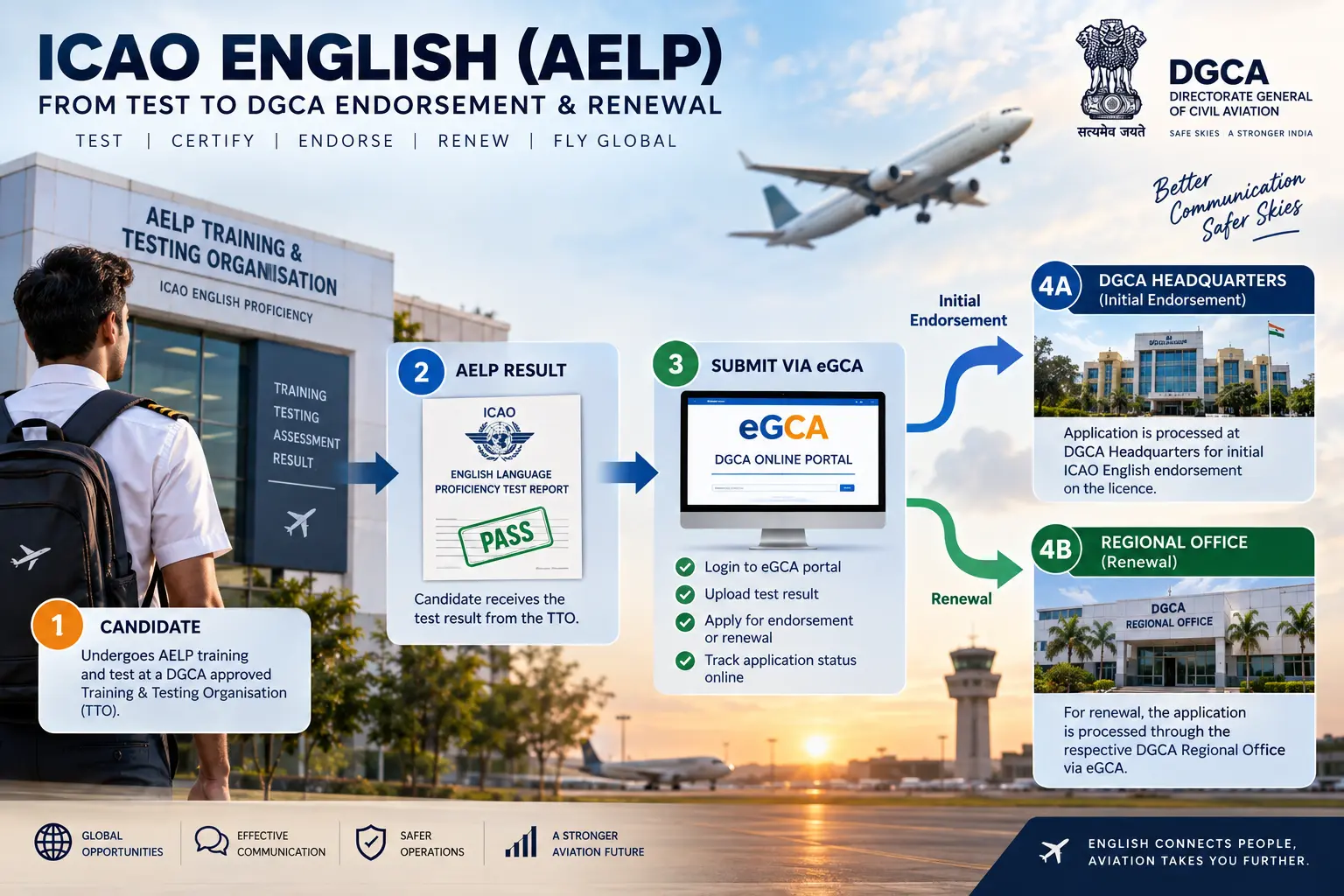
DGCA does not run the assessment itself. It is conducted by Aviation English Language Proficiency (AELP) training and testing organisations that DGCA recognises for the purpose, and DGCA-recognised providers report that CAR Section 7, Series ‘G’, Part III requires a minimum of 30 hours of AELP training before a candidate sits the test itself. DGCA’s own CAR library sits behind a portal this site could not retrieve a copy from, so that hour figure is stated as reported by providers who cite the CAR, not as a number this site has confirmed against the document — check it directly with your chosen AELP organisation before you plan a study schedule around it.
What is confirmed, from DGCA’s eGCA manual, is the endorsement route: an AELP training and testing organisation forwards a candidate’s result to DGCA headquarters for an initial endorsement, and to the relevant regional office for a renewal, through the eGCA portal. The assessment itself is typically a structured spoken interview built around aviation scenarios — radio calls, abnormal situations, coordination with crew and ground staff — rather than a written grammar test, because what the scale measures is real-time operational communication, not classroom English.
ELP vs RTR (A): two different requirements
The two get confused because both involve speaking into a microphone and both are examined outside the five DGCA written papers. That is where the similarity ends.
| Aspect | English Language Proficiency (ELP) | RTR (A) |
|---|---|---|
| What it tests | General operational ability to communicate in English, scored across six descriptors | Radiotelephony procedure and phraseology |
| Governing instrument | CAR Section 7, Series ‘G’, Part III (cited by identity — see note below) | Radio Telephone Operator (Restricted) Certificate and Licence Rules, 2025 |
| Who conducts it | DGCA-recognised AELP training and testing organisations | Administered separately from the DGCA written papers |
| Minimum standard | ICAO Level 4 (Operational) or above | A pass in the written and practical radiotelephony assessment |
| Required for | PPL, CPL and ATPL issue | CPL issue, under Section J paragraph 1(g) — examined separately from the dgca written papers |
A pilot needs both, on file, before a CPL is issued. Clearing RTR (A) says nothing about your ELP result, and a strong ELP result does not substitute for RTR (A) either — DGCA checks both independently, and the eGCA prerequisite list above carries them as separate lines for exactly that reason.
How long does an ELP result last?
Under the ICAO scale generally, a Level 6 (Expert) result does not expire — it is the one rating high enough that periodic reassessment serves no purpose. Levels 4 and 5 are intended to be reassessed on an interval, because operational language ability can genuinely fade without use, and DGCA’s eGCA manual describes an AELP renewal being routed to a regional office rather than to headquarters, which only makes sense if renewal is a recurring step for most candidates.
What this site cannot state with confidence is the exact interval DGCA sets for a Level 4 or Level 5 renewal in India, because the CAR that would confirm it could not be retrieved from a government source. Figures circulate online for this, and they are not consistent with each other, which is precisely the situation where the right answer is to say so rather than pick one. Ask your AELP training and testing organisation for your specific result date and renewal window when you take the test, and keep the record with your other licensing paperwork.
Mistakes that delay a licence application
None of these are complicated once you know to check for them — they cost time mainly because students discover the requirement late.
- Assuming RTR (A) and the ELP test are the same requirement, or that clearing one clears the other. They are examined by different bodies against different standards.
- Leaving it until the licence application is otherwise complete. It sits alongside the medical, the e-logbook and the written papers as one of the gates DGCA’s own eGCA manual lists before a CPL application moves — there is no reason to treat it as an afterthought.
- Booking with an organisation without checking it against DGCA’s own published list of recognised AELP training and testing providers first.
- Treating a strong school-leaving English mark as equivalent to an ELP result. It is not, and no such substitution exists.
- Not asking, in writing, when a Level 4 or Level 5 result is due for reassessment. DGCA sets the interval; this site could not confirm the exact figure from a retrievable document, and neither should you assume one.
Ground classes at We One Aviation
We have taught the DGCA ground subjects from Dwarka since 2009, and eligibility questions like this one — what has to be in place before an application moves, and in what order — are usually the first conversation we have with a student. Our flight school prerequisites guide covers the full admission sequence step by step.
We teach the DGCA ground subjects and arrange flight training with partner flying schools. We do not own aircraft or simulators, we do not employ pilots, and we do not place students into airline jobs — hiring decisions rest with the operator.
People also ask
Is the DGCA English Language Proficiency test the same as RTR (A)?
No, and confusing the two is the single most common mistake students make. RTR (A) tests radiotelephony procedure and phraseology, under the Radio Telephone Operator (Restricted) Certificate and Licence Rules, 2025. English Language Proficiency tests general operational ability to communicate in English against the ICAO Language Proficiency Rating Scale. Both are required, both are examined separately from the five DGCA written papers, and clearing one says nothing about the other.
What happens if I score below Level 4 on the ELP test?
Your assessment result simply does not meet the licence-issue threshold and the CPL application cannot move on that basis. DGCA does not publish a mandatory waiting period before a reassessment that this site could confirm from a retrievable document, so the practical answer is to ask your AELP training and testing organisation directly what a resit involves and when you are eligible for one.
Do I need the ELP test for a Student Pilot Licence, or only for the CPL?
Have cleared the English Language Proficiency examination at Level 4 or above is explicit for the Commercial Pilot Licence application, in DGCA's own eGCA user manual. This site found no equivalent published requirement at the Student Pilot Licence stage. If a flying school asks you for an ELP result earlier than that, confirm in writing why, rather than assuming it is a universal rule.
Where do I actually take the DGCA ELP test?
Only through a DGCA-recognised Aviation English Language Proficiency (AELP) training and testing organisation. We teach the DGCA ground subjects and do not conduct or arrange ELP assessments ourselves, so we will not name or rank specific centres here — check DGCA’s own published list of recognised AELP organisations before paying anyone for this.
Does scoring well in Class 12 English exempt me from the ELP test?
No. A school-leaving English result and an aviation ELP assessment measure completely different things. The ELP test is a spoken, operational assessment built around aviation communication scenarios, scored against six separate descriptors, and there is no substitution or exemption route based on an academic English mark.
Can a native English speaker skip the ELP test?
No — every CPL applicant’s file needs a recorded ELP result at Level 4 or above, regardless of first language. What a fluent speaker can realistically expect is a Level 6 (Expert) result, and Level 6 is the one rating that does not need periodic reassessment, so a strong result the first time is the closest thing to skipping it that actually exists.
Related guides
- For the full admission paperwork and the order everything happens in, read the flight school prerequisites guide
- For the five written papers, pass marks and paper validity, see the DGCA exam guide
- For every other CPL eligibility requirement in one place, read the CPL eligibility guide
- For RTR (A) itself, under the 2025 Rules, see our RTR (A) guide
- For what a Commercial Pilot Licence course covers end to end, see the CPL course page