
CPL flying hours
Night Flying Hours for a CPL in India: The 5-Hour Rule Explained
By We One Aviation Academy · Published · 8 min read
Last updated:
Quick Answer
What is the night flying requirement for a CPL in India?
A Commercial Pilot Licence in India requires 5 hours of night flying as pilot-in-command, including at least 10 take-offs and 10 landings, under Schedule II, Section J of the Aircraft Rules, 1937. These hours sit inside the 200-hour CPL total, not in addition to it, alongside the pilot-in-command, cross-country and instrument-time components.
The requirement, in one view
- •Night flying: 5 of the 200 total hours, clause 1(e)(iv)
- •At least 10 take-offs and 10 landings, logged as pilot-in-command
- •All hours and all take-offs and landings must be flown in an actual aircraft — no simulator allowance applies
- •It sits inside the 200-hour total, not on top of it, the same caution that applies to every CPL_HOURS component
- •The whole 200-hour total, night hours included, must be flown within 5 years of applying
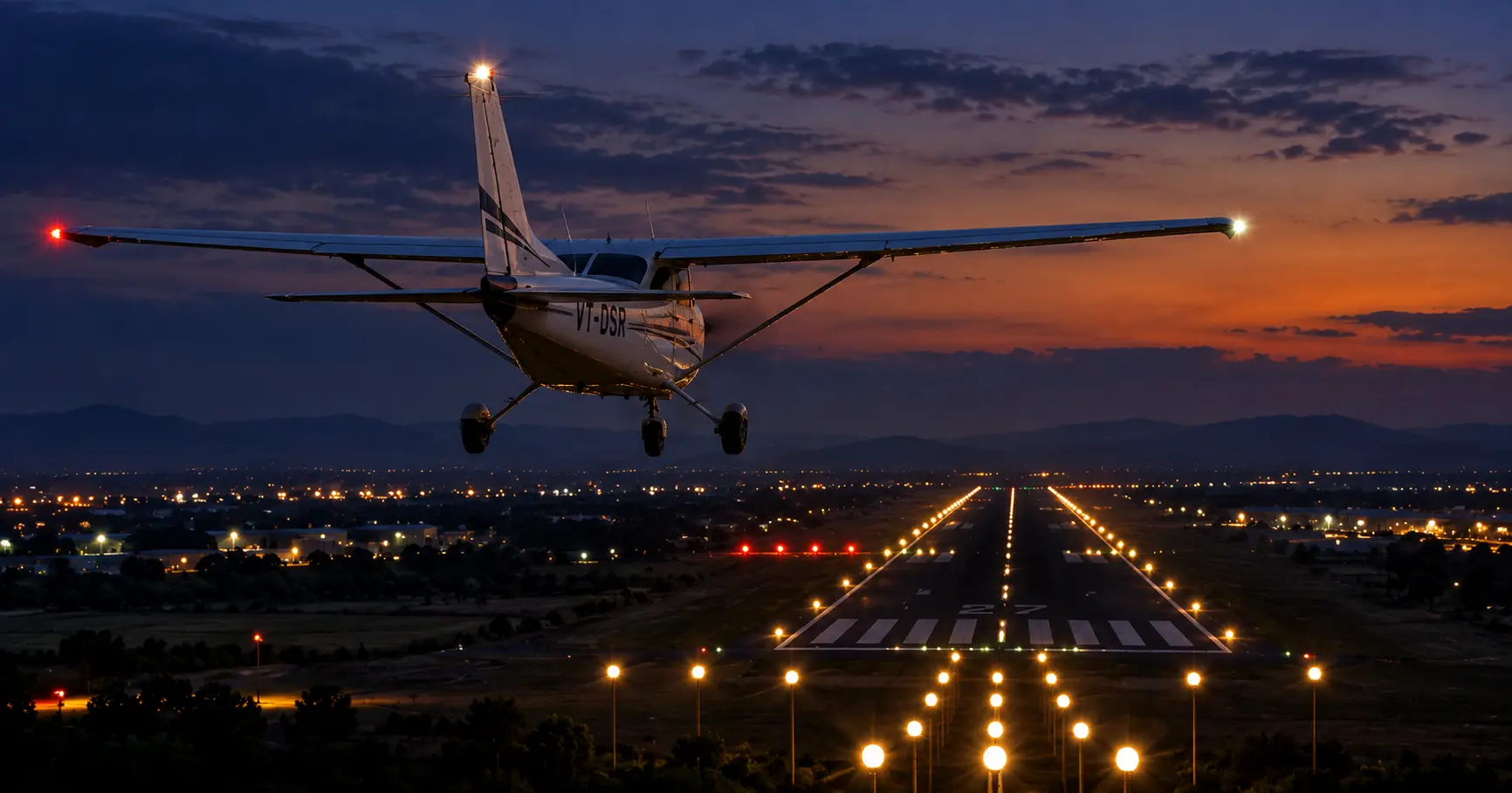
What is the night flying requirement for a CPL in India?
5 hours of night flying as pilot-in-command, under clause 1(e)(iv) of Schedule II, Section J of the Aircraft Rules, 1937, including at least 10 take-offs and 10 landings. Those hours sit inside the 200-hour CPL total — they are not added on top of it, in the same way the cross-country, instrument-time and pilot-in-command components each sit inside the total rather than beside it.
including at least 10 take-offs and 10 landings as pilot-in-command. It is the smallest of the four hour components by count, but it is also the one most dependent on things outside a student’s control — clear skies after dark and an aircraft cleared for night operations — which is why schools plan for it early rather than leaving it for the end of a course.
Where night flying sits inside the 200-hour total
It helps to see this component next to the other three, because the most common error students make with any single row of Schedule II is treating it as an addition to the total rather than a slice of it.
| Component | Hours | Clause | Note |
|---|---|---|---|
| Pilot-in-command | 100 | 1(e)(i) | of which not less than 15 hours in the six months before applying |
| Cross-country as PIC | 20 | 1(e)(ii) | including one flight of at least 300 nautical miles with full-stop landings at two different aerodromes |
| Instrument time | 10 | 1(e)(iii) | of which not more than 5 hours may be on an approved simulator |
| Night flying | 5 | 1(e)(iv) | including at least 10 take-offs and 10 landings as pilot-in-command |
5 hours is a small fraction of 200, which is exactly why the take-off and landing count matters more than the hour figure alone — a student could log the hours on longer night cross-country legs and still fall short of the requirement if the take-offs and landings were not built in deliberately.
The 5-hour condition, item by item
Three things have to be true together: the hours, the take-offs, and the landings. Missing any one of them means the component is not satisfied, however many night hours are logged overall.
| Condition | What it requires |
|---|---|
| Hours required | 5 hours of night flying, clause 1(e)(iv) |
| Role flown | Logged as pilot-in-command |
| Take-offs | At least 10, as pilot-in-command |
| Landings | At least 10, as pilot-in-command |
| Where it counts | Inside the 200-hour CPL total, not in addition to it |
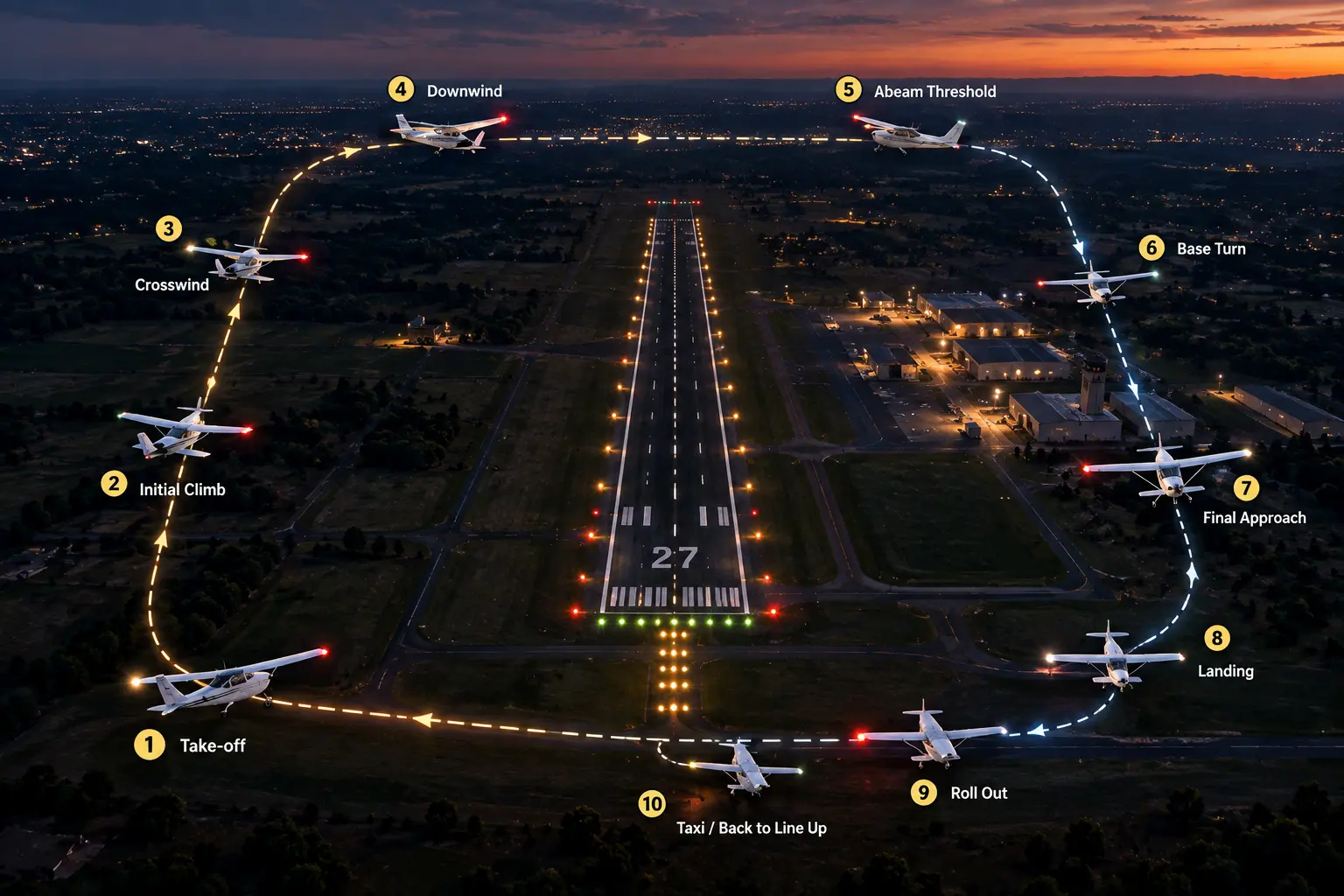
In practice, the 10 take-offs and 10 landings are usually flown as repeated circuits at the same aerodrome rather than spread across separate cross-country legs — it is the most direct way to build the count without depending on multiple clear nights at multiple airfields.
What counts as "night" for logging purposes?
Schedule II and the wider Aircraft Rules, 1937 set the technical boundary of night for logging purposes, and it is not simply "after sunset by eye." Rather than restate a specific time boundary here without a primary source in hand to verify it against the currently notified text, read the definition directly on the DGCA's Aircraft Rules portal and confirm it with your flying school before your first night session, since a school’s logbook and dispatch records need to agree with the notified definition, not with a rule of thumb.
What matters for planning purposes is that the boundary is fixed by rule, not by convenience — a flight logged as night has to actually fall inside that window, which is one more reason schools build a margin into how they schedule these sessions rather than starting exactly at the edge of it.
Why does a CPL require night flying experience?
Because a commercial licence has to certify competence in conditions a private pilot may never need to fly in. Night flying changes almost everything about how a pilot perceives the runway environment — depth cues, horizon reference and even how quickly the eyes adapt after looking at a lit instrument panel all behave differently after dark, and a licence that permits flying for payment has to certify that a pilot has actually handled those conditions, not just studied them.
The take-off and landing count, rather than the hour count alone, is what turns this from a general exposure requirement into a demonstrated skill: repeated circuits force a student to judge the same runway, the same lighting and the same sight picture multiple times in one session, which is a different kind of learning from a single long night cross-country flight.
How flying schools structure night training
Night training is one of the more schedule-sensitive parts of a syllabus, so most schools treat it as a distinct block rather than something fitted in whenever a slot is free. A typical approach batches the required circuits into two or three sessions on consecutive clear nights, both to make efficient use of an aircraft cleared for night operations and to avoid the gap between sessions growing long enough that earlier training has to be partly repeated.
Aerodrome choice matters too. A base with reliable night operating hours and approach lighting gives a school more usable nights across a month than one where night operations depend on additional coordination, and this is one of the practical differences worth asking about when comparing training programmes.
Mistakes that delay the night flying requirement
Most delays here come down to scheduling rather than skill, and they are avoidable with planning rather than luck on the clear night in question.
- Leaving night training until the very end of the syllabus, so a stretch of poor weather or aircraft unavailability sits directly on the critical path to the licence.
- Treating the hour figure as the whole requirement and under-planning the take-off and landing count, then needing an extra session purely to make up circuits.
- Spacing sessions too far apart, so skills built in the first session need to be partly relearned rather than built on in the next.
- Assuming any late-evening flight qualifies as night time without confirming it actually falls inside the notified definition your school logs against.
- Not confirming in advance which take-offs and landings will be logged as pilot-in-command, then discovering some were flown dual and do not count toward the condition.
What happens after you complete it
Once flown and correctly logged, the night hours and the take-off and landing count are recorded in your logbook against clause 1(e)(iv) the same way any other component is, and they count toward the 200-hour total alongside your pilot-in-command, cross-country and instrument time. There is no separate certificate for it beyond the logbook entry and your instructor’s sign-off — it is one line item inside the same record that eventually supports your CPL application.
From there, training continues toward the rest of the 200 hours: the cross-country component (covered in our cross-country flight requirement guide), and the instrument time with its own simulator cap (covered in our simulator hours guide). None of those depend on night flying having been completed first, so schools sequence it wherever it fits their own syllabus, aircraft availability and the weather.
Ground classes at We One Aviation
We have taught the DGCA ground subjects from Dwarka since 2009, and questions about how the flying-hour requirements fit together — night flying, cross-country, instrument time, and the ground syllabus running alongside them — come up constantly from students planning their timeline before they commit to a flying school.
We teach the DGCA ground subjects and arrange flight training with partner flying schools. We do not own aircraft or simulators, we do not employ pilots, and we do not place students into airline jobs — hiring decisions rest with the operator.
People also ask
Do the 10 night take-offs and landings have to be flown solo?
They have to be logged as pilot-in-command time, which at the stage most schools schedule night training normally means solo, the same way the CPL cross-country flight is normally solo for the same reason. Confirm the exact arrangement with your flying school, since some of the surrounding night hours may be flown dual for training before the solo take-offs and landings are logged.
Can night flying hours be logged on a simulator?
No. The only simulator allowance inside the 200-hour CPL total sits in the instrument-time component, where up to 5 of the 10 hours may be flown on an approved simulator. Night flying has no such allowance in Schedule II — all 5 hours, and all 10 take-offs and landings, have to be flown in an actual aircraft.
Does night flying time also count toward the instrument-time requirement?
Not by default. Night flying and instrument time are separate components of the 200-hour total, each with its own clause and its own conditions. A night flight only counts toward instrument time if it is specifically flown to meet that component too, such as under instrument conditions with an instructor logging it accordingly.
Do the night hours need to be recent, like the pilot-in-command recency requirement?
The whole 200-hour total, night hours included, has to be flown within 5 years of your CPL application under the same recency clause that governs the total. A separate, tighter condition — 15 hours of pilot-in-command time in the six months before applying — attaches only to the pilot-in-command component, not specifically to night hours.
What if bad weather or aircraft availability delays night training?
Night flying depends on clear weather after dark and an aircraft cleared for night operations, which makes it one of the more schedule-sensitive parts of the syllabus. Most flying schools batch night training into short, deliberate windows rather than spreading it thinly, precisely because a single missed slot can mean waiting for the next clear night rather than the next available daylight one.
Related guides
- For the other flight-planned component inside the same 200 hours, read our CPL cross-country flight requirement guide
- For how the simulator cap works on the instrument-time component, see our CPL simulator hours guide
- For the full licence ladder and how the 200-hour total fits the wider training path, read our complete guide to pilot training
- The full CPL flying and eligibility requirements are set out on the CPL course page
- For the DGCA ground subjects that run alongside your flying phase, see the DGCA ground classes page