
DGCA ground school
DGCA Ground School (2027): How to Prepare for and Clear the Five Papers
By We One Aviation Academy · Published · 11 min read
Last updated:
Quick Answer
What is DGCA ground school?
DGCA ground school is the theory stage of pilot training in India: preparation for the 5 DGCA written papers (Air Navigation, Aviation Meteorology, Air Regulations, Technical General and Technical Specific), each passed separately with 70%, plus RTR (A), examined on its own. Papers are attempted one or two at a time across DGCA's sessions, so the order you take them in matters as much as how much you study.
Ground school at a glance
- •5 papers: Air Navigation, Aviation Meteorology, Air Regulations, Technical General and Technical Specific.
- •70% in each paper on its own; no aggregate.
- •RTR (A) is a separate examination, not a sixth paper.
- •No medical needed to study or to sit the papers; a computer number is.
- •4 regular DGCA sessions a year plus on-demand sessions.
- •Sources: Civil Aviation Requirement, Section 7, Series 'B', Part I, Rev. 2 dated 13 February 2019; Pariksha documents read 2026-09-11.
Most students start DGCA ground school with a stack of books and a plan to “finish the syllabus”, then sit all five papers together. A few weeks later they have passed two, carry three into the next session, and the six months they budgeted for theory has quietly doubled. The papers are not unusually hard; the plan was. DGCA ground school rewards a different approach: understanding what each paper actually tests, attempting them in a deliberate order, and treating a failed paper as a diagnosis rather than a setback. This guide sets that approach out, paper by paper.
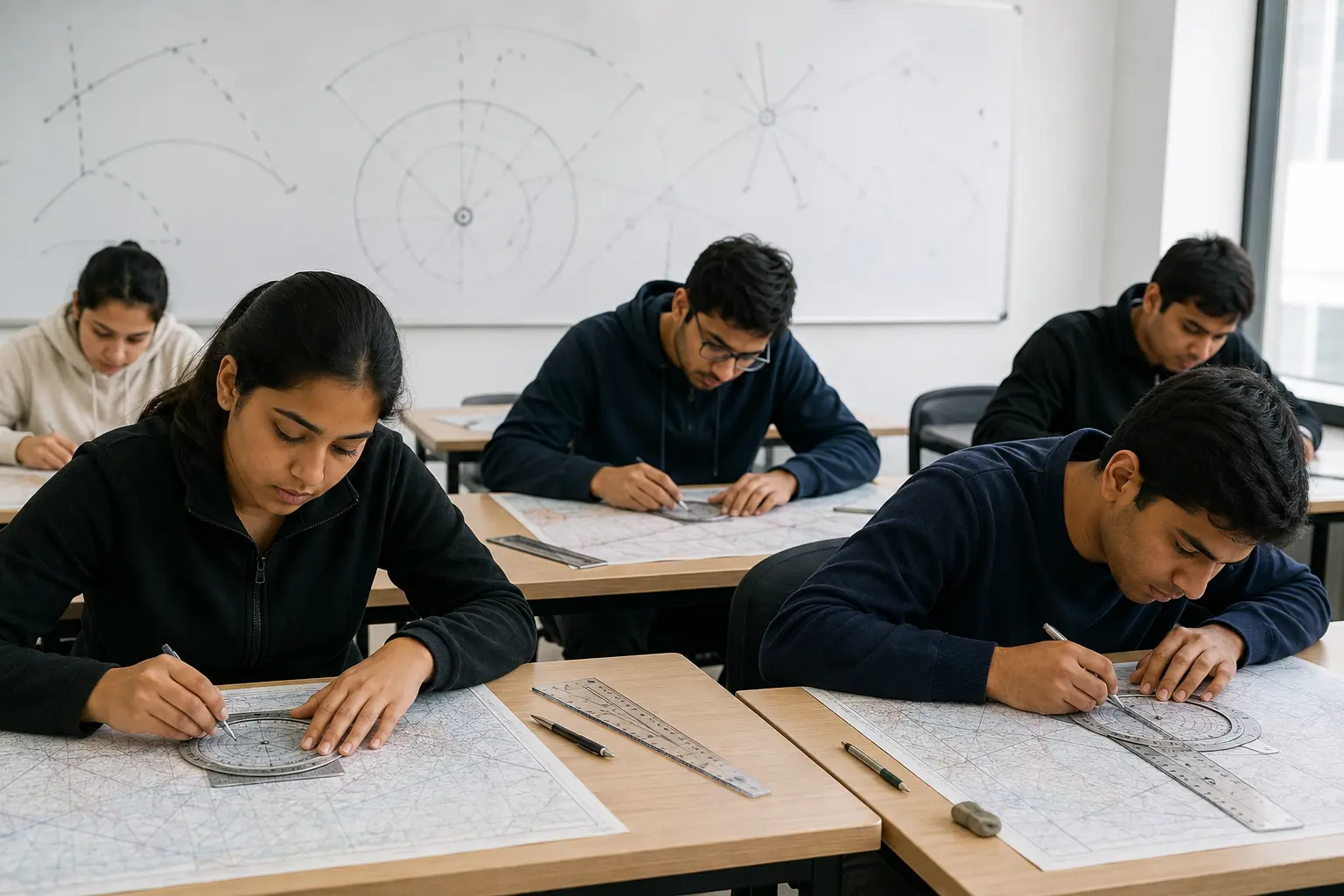
What is DGCA ground school?
DGCA ground school is the theory stage of pilot training in India, preparing you for the 5 written papers DGCA examines and for RTR (A), which is examined separately. Passing the papers is a licence requirement under Schedule II, Section J, and no amount of flying replaces it.
It also matters for a reason beyond the examination. Ground school is where you learn why an aircraft behaves as it does, and students who arrive at the flying school with Technical General understood spend their expensive hours flying rather than being taught on the ground at flying rates.
Who can join DGCA ground school?
Anyone can join DGCA ground school; the requirements apply to the licence, not to studying. For the CPL you will need Class 10+2 with Physics and Mathematics from a recognised Board or University, and the licence is issued at 18 or later, but many students start classes while still in Class 12.
Students from a Biology or Commerce stream are not shut out: students from a Biology or Commerce stream clear both subjects as private candidates through NIOS and then apply. The medical is not needed to join or to sit the papers, but take it early anyway. Book the Class 1 initial before committing money to a flying school. The student pilot licence only needs a Class 2, but the licence you are training towards needs a Class 1 — and finding a disqualifying condition after paying a deposit is an expensive way to learn it.
What does each DGCA paper demand?
Each DGCA paper demands something different: Air Navigation is timed calculation, Meteorology is applied understanding, Air Regulations is memory, and the two Technical papers are applied physics, generic and then type-specific. The notes below are from our experience of teaching these subjects; DGCA publishes no pass rates by paper.
| Paper | What it demands | How to prepare |
|---|---|---|
| Air Navigation | Arithmetic under time pressure. In our classes, the students who struggle are the ones who read it rather than worked it. | Timed problems from the first week, marked and reviewed. |
| Aviation Meteorology | It reads easily and examines precisely; memorised definitions do not survive application questions. | Decode a live METAR and TAF for a nearby airport every day. |
| Air Regulations | Largely memory work, and best learned little and often. | Spaced repetition, working from the regulations themselves. |
| Technical General | Applied physics; it rewards understanding the mechanism behind each figure. | Derive before you memorise. A number you can explain is a number you remember. |
| Technical Specific | Narrower than Technical General and tied to one type. | Work from the manual of the type you have actually named; your flying school can tell you which. |
Air Navigation
Charts and projections, dead reckoning, flight planning, fuel, radio navigation aids and position fixing.
Aviation Meteorology
The atmosphere, pressure systems, wind, cloud, visibility, icing, thunderstorms, turbulence, and reading METAR and TAF.
Air Regulations
The Aircraft Rules, the ICAO Annexes, rules of the air, licensing, documents to be carried and airspace.
Technical General
Aerodynamics, airframes, piston and turbine engines, propellers, instruments and systems, taught generically.
Technical Specific
The same technical ground applied to the aircraft type you name: its systems, limitations and performance.
DGCA’s own list of study material names the reference books for each subject; the CAR carrying the topic-by-topic CPL syllabus could not be retrieved from a government server, so this page does not reproduce one. The titles are set out in DGCA recommended books for the CPL exams.
Where does RTR (A) fit in ground school?
RTR (A) sits outside the five DGCA papers. Examined separately from the DGCA written papers, and required for CPL issue under Section J paragraph 1(g). It is examined under the Radio Telephone Operator (Restricted) Certificate and Licence Rules, 2025, so it needs its own preparation slot rather than a place in your paper rotation.
The phraseology is a spoken skill, so practise it aloud rather than reading it. Our RTR (A) page explains the examination.
How should you sequence your DGCA attempts?
Sequence DGCA attempts one or two papers per session, starting with the ones you are ready for, rather than all five at once. Each paper is passed on its own with 70%, so small groups across sessions spread the load and stop one weak paper from dragging the others.
- Get the computer number first. No paper can be booked without it; apply on the Pariksha portal.
- Know the calendar. DGCA holds 4 regular sessions a year, listed in its Programme of Examinations, plus on-demand sessions at ₹5,000 a paper against ₹2,500.
- Watch the window. For the issue of a CPL or an ATPL, that period is five years. Clearing papers years before you finish your flying hours is not free. Count backwards from the licence application, not forwards from the first paper.
The booking rules, fees and session dates are all in our DGCA exam guide.
What does a sensible DGCA study plan look like?
A sensible DGCA study plan starts Air Navigation practice in the first week, puts the first attempt early with two papers you are ready for, and keeps RTR (A) in its own slot. The plan below is our suggestion, not a DGCA requirement; adjust it to the sessions you can sit.
| Stage | Focus |
|---|---|
| Weeks 1–4 | Air Navigation fundamentals with timed practice from the start, and Air Regulations. |
| Months 2–3 | Technical General alongside continuing Navigation. Begin Meteorology and daily METAR decoding. |
| First session | Attempt two papers you are ready for, often Air Regulations and Meteorology. |
| Following months | Technical Specific for your type, Navigation consolidation, and RTR (A) preparation in its own slot. |
| Later sessions | The remaining papers, one or two at a time, watching the five-year window from your first pass. |
What should you do after failing a DGCA paper?
After failing a DGCA paper, work out whether you ran out of knowledge or out of time, change how you practise accordingly, and rebook only that paper. The failure touches nothing else: every other paper stands or falls on its own.
- Work out whether it was knowledge or time. Running out of time needs timed drills; wrong answers need the concept retaught. The two look the same on a result and need opposite fixes.
- Do not rebook on the same preparation. Change how you practise before you book again, or the next result will look the same.
- Keep the other papers moving. Each paper needs 70% on its own, so a failure touches only that paper.
- Use the gap. The wait until the next session is study time you did not plan for. Spend it on the weak area.
How do you choose a DGCA ground school?
Choose a DGCA ground school on how it prepares you, not on its facilities: whether mock tests are timed and marked, who answers doubts, and what its students achieved last year. DGCA does not approve classroom institutes, so “DGCA approved” on a coaching banner is not something you can look up.
Ask each school, in writing:
- What share of last year’s students cleared each paper at the first attempt?
- Are mock tests timed and marked by an instructor, or self-scored?
- Who answers doubts, and how quickly?
- What happens, in writing, if you have not cleared a paper by the end of the course?
- Can classes be taken online if you move to a flying school in another state?
Ground school and flying school are separate choices. The papers are examined by DGCA wherever you studied, so you can clear theory in one place and fly in another; our online ground classes page explains what can be done remotely.
The short version
Get the computer number, start Navigation practice on day one, sit two papers at a time, and treat a failure as information about how you practised. Keep the five-year window in view from your first pass. Done that way, ground school becomes the most predictable part of pilot training rather than the part that runs a year late.
We teach the DGCA ground subjects and arrange flight training with partner flying schools. We do not own aircraft or simulators, we do not employ pilots, and we do not place students into airline jobs — hiring decisions rest with the operator.
People also ask
What is DGCA ground school?
DGCA ground school is the theory stage of pilot training in India. It prepares you for the 5 DGCA written papers, Air Navigation, Aviation Meteorology, Air Regulations, Technical General and Technical Specific, each needing 70%, with RTR (A) examined separately under its own rules.
How long does DGCA ground school take?
No regulation sets the length of DGCA ground school; courses are set by each institute. What decides how long the theory stage really takes is how many papers you attempt per session and how many you pass first time, since each paper waits for the next session if it is failed.
Can I attempt DGCA papers while still in ground classes?
Yes, and it is usually the better plan. Papers are passed one at a time, so attempting two while studying the rest spreads the load across sessions. You need a DGCA computer number first, which can be applied for from age 16.
Which DGCA paper is the hardest?
DGCA publishes no pass rates by paper, so no one can say which is hardest with data. In our teaching experience, Air Navigation is the one students most often under-prepare for, because it is examined under time pressure and rewards worked practice over reading.
How often are the DGCA exams held?
DGCA holds 4 regular sessions a year, plus on-demand sessions at a higher fee. In 2026 the regular sessions are 10–14 March 2026; 16–20 June 2026; 22–26 September 2026; 15–19 December 2026, which DGCA marks as tentative.
Is online DGCA ground school as good as classroom?
Online ground school can work as well as a classroom when it includes live doubt sessions and timed, marked mock tests. What separates outcomes is whether someone marks your worked problems and answers your questions, not the medium. Recorded lectures alone are the weak form of either.
Do I need a medical before joining ground school?
No medical is needed to join ground school or to sit the DGCA papers. It is still wise to take the Class 1 medical early, before paying a flying school, because a finding there decides whether the licence route is open.
What books does DGCA recommend for ground school?
DGCA publishes a list of study material for the PPL, CPL and ATPL exams on the Pariksha portal. DGCA advises candidates to refer to the relevant topics as per the prescribed syllabus in the CAR, covered in these reference books, for the category of pilot licence examination they intend to appear for. It is a reference list, not a required purchase.
Related guides
- Fees, sessions, booking and the pass rules are in our DGCA exam guide
- The books DGCA names for each subject are listed in DGCA recommended books
- Why a pass can lapse before your licence application is in the five-year rule
- The computer number you need before booking is in our computer number guide
- Our own classes, batches and syllabus are on the DGCA ground classes page
Primary sources
The documents this guide was checked against, last read 8 October 2026. They are published by the regulator or the government body named, and can change, so the document wins if it disagrees with this page.
- Civil Aviation Requirement, Section 7, Series 'B', Part I, Rev. 2 dated 13 February 2019 — Eligibility criteria for examinations for issue of crew licences (DGCA)
- Programme of Examinations 2026 (DGCA Pariksha)
- Flight Crew User Manual, Issue III Rev 0, October 2024 (DGCA Pariksha)
- List of Study Material for PPL, CPL and ATPL examinations conducted by DGCA (DGCA Pariksha)
- CAR Section 7, Series 'B', Part VI, Issue III, 16 June 2011 — syllabus for the ATPL (Aeroplanes) examination (DGCA)