
Pilot career guide
Instrument Rating for Pilots in India: What It Is and Why CPL Holders Need One
By We One Aviation Academy · Published · 9 min read
Last updated:
Quick Answer
What is an Instrument Rating and do CPL holders in India need one?
An Instrument Rating (IR) is a separate qualification, endorsed on top of a licence, certifying a pilot to fly relying on instruments alone when weather or visibility rules out visual reference. It is distinct from the 10 hours of instrument time already inside CPL flying, typically costs ₹3,00,000–₹4,50,000 in India, and is a standard prerequisite before type rating training and most First Officer roles.
The essentials, in one view
- •Distinct from the 10-hour instrument-time component already inside the 200-hour CPL requirement (1(e)(iii))
- •Certifies flying by instruments alone, without outside visual reference — its own ground syllabus, flight training and skill test
- •Sometimes sold combined with CPL training as "CPL with IR"; confirm in writing rather than assuming it is included
- •Typical cost in India: ₹3,00,000 – ₹4,50,000, when purchased as a standalone add-on
- •A standard prerequisite before type rating training — most TRTOs check for a valid IR before enrolment
- •The privilege lapses without recency, the same pattern as a type rating
- •Not one of the 5 DGCA written papers — it is a flying qualification, examined separately
What is an Instrument Rating?
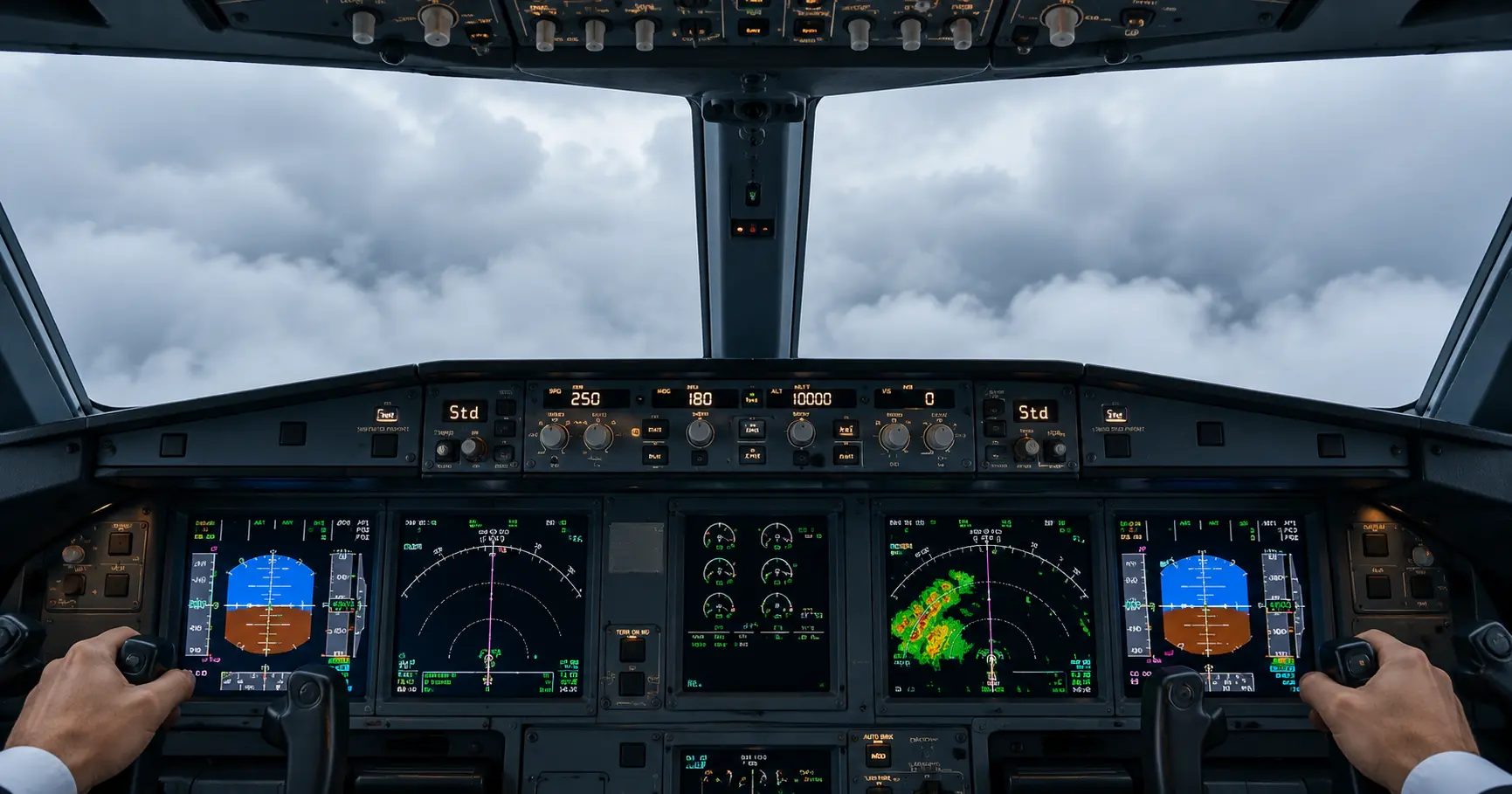
An Instrument Rating is a qualification endorsed on a pilot’s licence certifying that they can fly and navigate relying on the aircraft’s instruments alone, in conditions where cloud, haze or darkness rule out flying by outside visual reference. It sits on top of a Private or Commercial Pilot Licence rather than being folded into it, and it is trained, examined and endorsed as its own stage.
The distinction matters because two different things share the word “instrument” in most CPL conversations, and mixing them up costs students a genuine surprise partway through training.
Isn’t this already inside my CPL?
Partially, and this is where the confusion starts. Every CPL flying record includes 10 hours of instrument time under 1(e)(iii), of which not more than 5 hours may be on an approved simulator. That is a component inside the 200-hour CPL total — exposure to instrument flying during initial training, logged and checked as part of the licence itself. It is not the standalone Instrument Rating, which has its own ground subjects, its own procedural flight training and its own skill test, and which gets endorsed separately once you pass it.
| Aspect | Instrument time inside CPL | Standalone Instrument Rating |
|---|---|---|
| What it is | 10 hours logged as part of the 200-hour CPL requirement | A separate rating endorsed on the licence, with its own syllabus and skill test |
| Clause | 1(e)(iii) | Governed separately from Section J, the clause that sets out the CPL itself |
| What it proves | Exposure to flying by instruments during initial training | Competence to fly relying on instruments alone, in conditions that rule out visual reference |
| Examined how | Logged and checked as part of the CPL flying record | A dedicated ground syllabus, flight training and a separate skill test |
| Required for | CPL issue — it is one component inside the total | Most airline First Officer roles, and a standard prerequisite before type rating training |
Why CPL holders need a standalone IR
A CPL alone qualifies you to be paid to fly. It does not, on its own, qualify you to operate in the weather an airline schedule cannot simply wait out. Most First Officer roles expect a current Instrument Rating well before an interview, and it is one of the standard checks a Type Rating Training Organisation runs before accepting a candidate, because type rating training and checking are conducted under instrument flight rules for most of the syllabus. Arriving at that stage without one does not fail the type rating course — it stops you from starting it.
What governs it under DGCA rules
The Instrument Rating sits under Schedule II of the Aircraft Rules, 1937, the same schedule that sets out the CPL itself under Section J. DGCA circulars on rating renewal reference the Instrument Rating separately, as its own section of the Schedule — distinct from Section J, and examined on its own syllabus rather than as one more topic inside the CPL written papers. It is not one of the 5 DGCA papers listed for the licence itself (Air Navigation, Aviation Meteorology, Air Regulations, Technical General, Technical Specific), and it is not RTR (A) either — it is a flying qualification with a ground and flight syllabus of its own. Confirm the current, exact clause wording on dgca.gov.in before relying on a number quoted second-hand.
What you need before you start
A flying school or TRTO checks every item below before accepting an Instrument Rating candidate. As with a type rating, missing one does not fail the training — it stops it from starting.
| Requirement | Detail |
|---|---|
| Private or Commercial Pilot Licence | Current and unrestricted. The Instrument Rating is an add-on to an existing licence, not a licence you can hold on its own. |
| Logged instrument flight experience | Your CPL's own 10 hours (1(e)(iii)) counts toward the total, but is rarely the whole requirement on its own. Confirm the current combined minimum directly with your TRTO or flying school — DGCA has amended rating experience tables before, most visibly on the ATPL side, so a figure quoted from an older source can go stale. |
| Current medical certificate | A DGCA medical certificate valid for the licence the rating is being added to, current through the training and the skill test, not only at enrolment. |
| RTR (A) | Instrument flying depends on continuous, precise radio communication with air traffic control, so a current radio telephony qualification is checked alongside the licence itself. |
How Instrument Rating training works
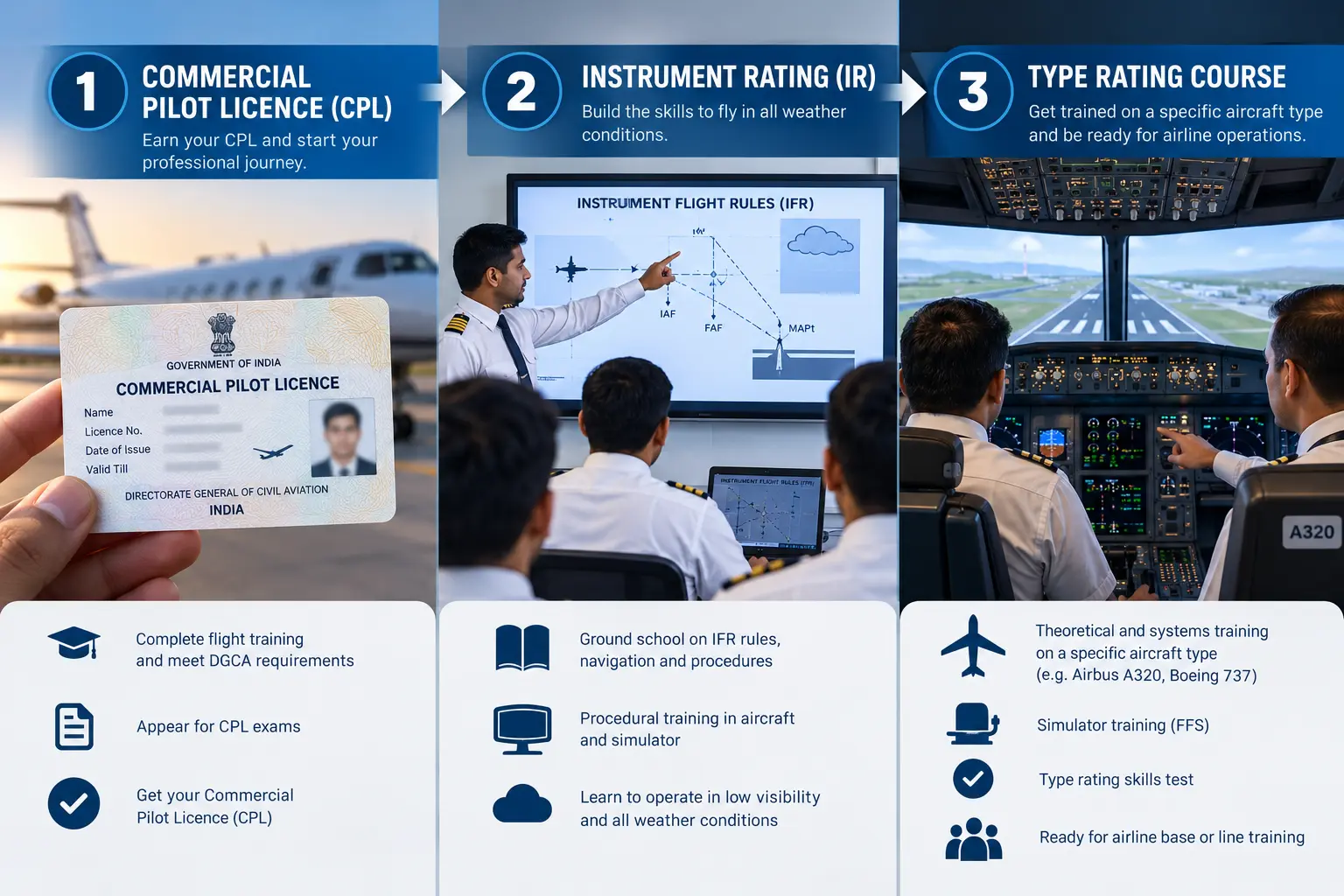
Four stages, in sequence. Ground school comes first because procedural flying makes very little sense without the navigation and meteorology theory behind it.
| Stage | What it involves |
|---|---|
| Ground school | Instrument flight rules, radio navigation aids, instrument meteorology and approach procedures — examined before flight training on the rating begins. |
| Procedural flight training | Holding patterns, instrument approaches and partial-panel handling, flown under a hood or in a simulator so outside visual reference is removed. |
| Skill test | A DGCA-authorised examiner conducts the Instrument Rating skill test; passing it is what gets the rating endorsed on the licence. |
| Endorsement and recency | Once endorsed, the privilege to use the rating depends on staying current — confirm the recency requirement with your school rather than assuming it is open-ended. |
What does an Instrument Rating cost?
Roughly ₹3,00,000 to ₹4,50,000 in India when purchased as a standalone add-on, the same figure maintained on our cost transparency page and repeated in our full training cost breakdown. Unlike a type rating or MCC, which are never inside a CPL quote, the Instrument Rating is marked “sometimes” included — several schools sell a combined “CPL with IR” package. Ask directly whether your quote is CPL alone or CPL with IR, because those are two different products at two different total prices, not the same course described two ways.
Keeping the rating current
Like a type rating, an Instrument Rating does not simply expire as a document, but the privilege to exercise it lapses without recency. Confirm the current recency requirement directly with your flying school or examiner rather than assuming a rating earned some years ago is still exercisable — this is exactly the kind of detail worth checking before, not during, a job application that assumes it.
IR vs type rating vs MCC — how they connect
These three get confused for the same reason a career moves through all of them around the same stage. Side by side, the sequence and the purpose become clearer.
| Aspect | Instrument Rating | Type rating | MCC |
|---|---|---|---|
| What it qualifies you to do | Fly by instruments alone, without outside visual reference | Act as crew on one specific aircraft type | Operate as one half of a two-pilot crew |
| Prerequisite for the others? | Standard prerequisite before type rating training | Not a prerequisite for IR or MCC | Requires a current Commercial Pilot Licence |
| Inside a CPL quote? | Sometimes — confirm in writing | Never | Never |
| Typical cost in India | ₹3,00,000 – ₹4,50,000 | ₹1,00,000 – ₹2,00,000 | ₹50,000 – ₹1,00,000 |
Read our type rating guide and our MCC training guide for what each of the other two actually involves — this page is deliberately the one that explains the Instrument Rating on its own terms rather than repeating either.
Mistakes that delay or waste it
- Assuming the instrument time inside your CPL record is the same thing as holding an Instrument Rating — it is a component of the total, not the rating itself.
- Accepting a CPL quote without checking whether "with IR" is actually included, then discovering it is a separate fee at the point you need it.
- Leaving the Instrument Rating until after other career steps, then finding it blocks the start of type rating training when a seat is already on offer.
- Letting recency lapse between finishing the rating and an actual job application, then needing to retrain before it is usable again.
- Treating the skill test as a formality after ground school, when procedural flying under a hood or in a simulator is a distinct skill that needs its own practice.
Ground classes at We One Aviation
We have taught the DGCA ground subjects from Dwarka since 2009. The Instrument Rating sits after the stage we teach, but questions about how it fits your timeline — whether to look for a combined CPL-with-IR programme or keep the two separate — are exactly the kind of planning conversation worth having before you enrol anywhere, not after.
We teach the DGCA ground subjects and arrange flight training with partner flying schools. We do not own aircraft or simulators, we do not employ pilots, and we do not place students into airline jobs — hiring decisions rest with the operator.
People also ask
Isn’t the Instrument Rating already included in my CPL?
Not fully. Your 200-hour CPL requirement includes 10 hours of instrument time (1(e)(iii)), of which not more than 5 hours may be on an approved simulator. That is instrument exposure inside CPL training, not the separate Instrument Rating itself, which has its own ground syllabus, flight training and skill test, and is endorsed on the licence separately.
Can I train for the Instrument Rating at the same time as my CPL?
Many Indian flying schools do sell it as a combined "CPL with IR" package, which is why cost-transparency pages mark it as "sometimes" included rather than never. Confirm in writing whether your quote covers it, because a school that quotes CPL alone and a school that quotes CPL with IR are not quoting the same product.
Do I need an Instrument Rating before a type rating?
Yes. A valid Instrument Rating is one of the standard prerequisites a Type Rating Training Organisation checks before accepting a candidate, because type rating training and checking run under instrument flight rules for most of the syllabus. Arriving without a current IR stops a type rating course from starting.
Does the Instrument Rating expire?
The rating stays on the licence, but the privilege to use it lapses without recency, the same pattern as a type rating. Confirm the current recency requirement with your flying school or examiner before assuming an old rating is still exercisable — do not plan a job application around it without checking first.
Is the Instrument Rating one of the five DGCA written papers?
No. The DGCA written examination for a CPL is 5 papers — Air Navigation, Aviation Meteorology, Air Regulations, Technical General, Technical Specific — and RTR (A) is examined separately again. The Instrument Rating is a flying qualification with its own ground and flight syllabus, outside that count entirely.
Related guides
- A valid Instrument Rating is a standard prerequisite before this stage — see our type rating guide
- For how this rating fits alongside MCC and ATPL in the wider career sequence, read our MCC training guide
- The Instrument Rating cost line, and every other fee in a training budget, is itemised on our pilot training cost breakdown
- For CPL eligibility, the ground subjects and the six-month syllabus, see the CPL course page
- For the licence that Instrument Rating experience eventually counts toward, see the ATPL course page