Pilot career guide
Multi-Crew Cooperation (MCC) Training in India: What It Is and Why CPL Holders Need It
By We One Aviation Academy · Published · 9 min read
Last updated:
Quick Answer
What is MCC training and why do CPL holders need it?
Multi-Crew Cooperation (MCC) training teaches a pilot to operate as one half of a two-pilot crew — sharing tasks, monitoring each other, and communicating to a standard procedure — rather than flying single-pilot. Airlines require it before a Commercial Pilot Licence holder can complete multi-crew line training. It is separate from a type rating and does not by itself qualify you to fly any specific aircraft.
MCC, in one view
- •MCC teaches the two-pilot working method — task-sharing, monitoring, CRM and standard callouts
- •It is not aircraft-specific and is not a substitute for a type rating
- •Prerequisite is a current Commercial Pilot Licence
- •Trained in a full-flight simulator, usually alongside or just before your first type rating
- •The cost-transparency figure on this site lists it at ₹50,000 – ₹1,00,000, never included in a CPL quote
- •Course length and exact structure vary by training organisation — DGCA does not publish one fixed syllabus duration
- •Confirm what your target airline requires before paying for it yourself; some sponsor it, some expect it already done
What is Multi-Crew Cooperation training?
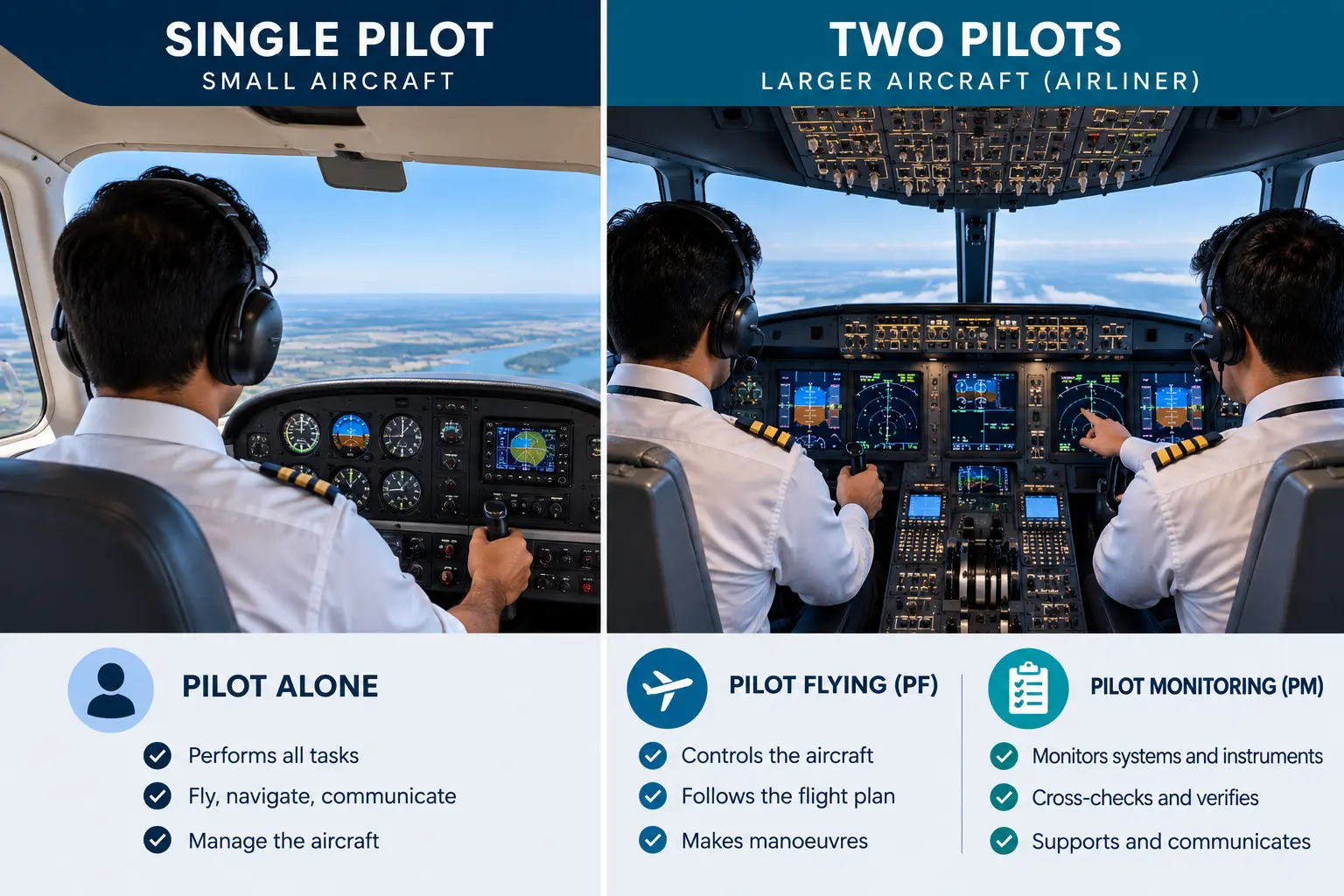
Multi-Crew Cooperation, almost always shortened to MCC, is training in how two pilots operate one aircraft together. It is not about flying skill in the stick-and-rudder sense — a CPL holder already has that from the 200 hours behind the licence. It is about the working method: who flies, who monitors, how each pilot communicates, and how the crew catches an error before it becomes a problem.
Every hour of CPL flying training in India is flown single-pilot. An airliner is not. MCC is the course that closes that gap, and it is examined and issued separately from the CPL itself, from any DGCA written paper, and from a type rating.
Why does a CPL holder need it?
Because a licence that qualifies you to be paid to fly does not, by itself, qualify you to work in a two-pilot cockpit. DGCA’s crew licensing and Crew Resource Management material, published on dgca.gov.in, sets out the multi-crew operating standards a flight deck runs to. Most Indian carriers either require MCC before considering a candidate for a First Officer role, or build it into the start of a cadet or type-rating programme they sponsor — either way, it sits between a bare CPL and a first flight as a First Officer.
The gap is easy to underestimate. A pilot who has only flown alone has never had to hand over control mid-task or cross-check another pilot’s checklist read, and logging more single-pilot hours does not teach it.
MCC vs type rating vs ATPL — how they differ
These three get confused constantly, because a career changes all three around the same stage. They answer different questions, and none of them substitutes for another.
| Aspect | MCC | Type rating | ATPL |
|---|---|---|---|
| What it qualifies you for | Working as one half of a two-pilot crew — task-sharing, monitoring and standard callouts | Acting as a crew member on one specific aircraft type | Acting as pilot-in-command of a commercial aeroplane, once age and experience conditions are met |
| Aircraft-specific? | No — the working method applies across multi-pilot aircraft in general | Yes — endorsed for one type, and often one variant | No — a licence tier, not an aircraft endorsement |
| Prerequisite | A current Commercial Pilot Licence | A current CPL, Class 1 medical, multi-engine rating and valid Instrument Rating | Minimum age 21, plus the experience conditions in Schedule II, Section M |
| Where it is trained | Full-flight simulator, at an organisation approved to run the course | DGCA-approved Type Rating Training Organisation (TRTO) | Ground school for the licence theory; experience is logged over years of flying |
| Typically taken | Once, before or alongside your first multi-crew type rating | Each time you add a new aircraft type | Once eligible, after CPL and while building command experience |
In practice a pilot usually meets all three around the same window: CPL first, then MCC and a first type rating close together — sometimes as a single combined course — with ATPL following years later once the command-experience conditions in Schedule II, Section M are met. For how a CPL and ATPL differ in full, see our CPL vs ATPL comparison.
What MCC training actually covers
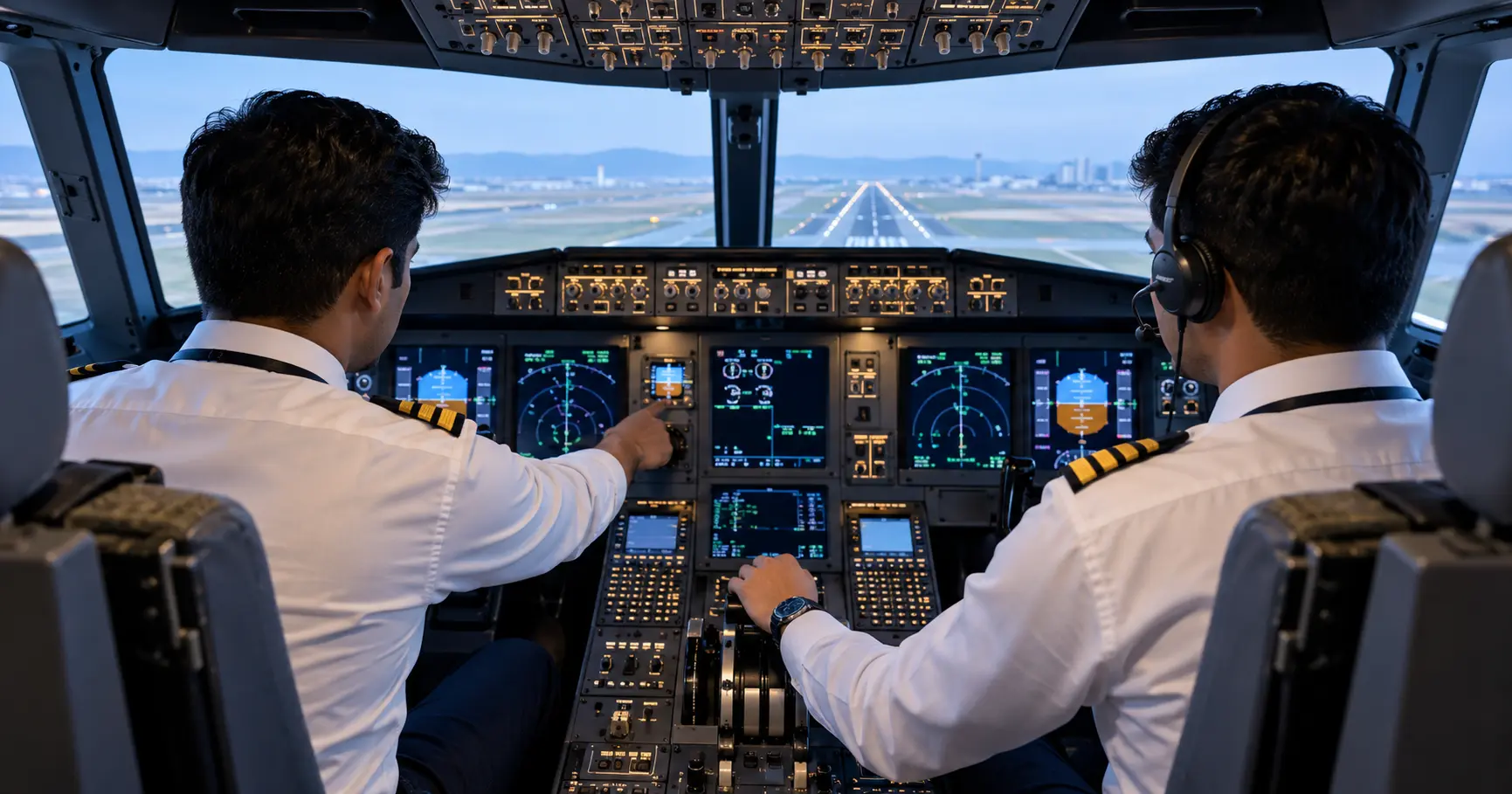
The course runs in a simulator, not a real aircraft, because the entire point is practising crew coordination under conditions — system failures, high workload, competing priorities — that would be reckless to stage for real. Five things get trained, in some order, at every provider.
| Module | What it trains |
|---|---|
| Crew Resource Management (CRM) | Communication, workload management, decision-making under pressure, and how a two-pilot crew catches errors a single pilot would miss. |
| Task-sharing and monitoring | Pilot Flying and Pilot Monitoring roles, standard callouts, and cross-checking each other’s inputs rather than each pilot working in isolation. |
| Normal and non-normal procedures | Running checklists and abnormal or emergency procedures as a coordinated crew, in a simulator built to a generic or specific multi-pilot aircraft. |
| Standard operating procedures (SOPs) | The discipline of following a shared, briefed procedure rather than individual technique, which is what makes two pilots from different training backgrounds able to fly together safely. |
| Threat and error management | Recognising developing problems early and managing them as a crew, rather than each pilot reacting independently once a problem is already serious. |
When should you do MCC training?
There is no single correct point on the timeline, because airlines do not all handle it the same way. Some carriers sponsor MCC as the first stage of a cadet or hiring programme, which means paying for it yourself in advance buys you nothing with that airline. Others expect a candidate to already hold it before they will shortlist an application at all.
The only reliable approach is to confirm what your specific target airline expects before spending on MCC independently. A self-sponsored MCC widens which roles you are eligible for the day you apply; an airline-sponsored one costs you nothing but locks you to that employer’s process and timeline.
What does MCC cost?
On our cost transparency page, Multi-Crew Cooperation training is listed at roughly ₹50,000 to ₹1,00,000, and — like a type rating — it is never included in a CPL training quote. Treat that as an indicative range rather than a quotation; get a written, itemised figure from any provider you are considering rather than budgeting off a headline number.
Course length is not standardised by DGCA into one fixed number of hours or weeks, and providers describe their own syllabi differently. Confirm current course content, duration and approval status directly with the training organisation before committing to a schedule.
Choosing an MCC provider
Price is the easiest thing to compare and the least useful one. What actually matters is whether the simulator and the instructing are run to a genuine multi-crew standard rather than a single-pilot syllabus with crew language added on top.
- Confirm the simulator is a genuine multi-crew configuration, not a single-pilot device used for two people.
- Ask whether the course is combined with a type rating, and if so, on which type — that decision commits you to an aircraft, not just a working method.
- Check instructor currency on multi-crew operations specifically, not only on the simulator hardware.
- Ask how CRM is assessed, not just delivered — a course that only lectures CRM without testing it under simulated pressure is not doing the job MCC exists for.
Mistakes that waste the investment
Almost every wasted MCC fee traces back to sequencing or a misunderstanding of what the course actually certifies, not to the training itself being poor.
- Booking MCC before confirming what your target airline actually requires — some sponsor it, some expect it already done, and paying in the wrong order wastes money.
- Assuming an MCC certificate is a type rating. It is not — you still need a separate, aircraft-specific type rating to fly a given type.
- Choosing a provider on price alone without checking the simulator standard and instructor currency. A CRM-heavy course only works when run to a genuine multi-crew standard.
- Leaving MCC until after an airline interview exposes the gap. It is one of the more predictable requirements in hiring, not a late-stage surprise.
- Treating the CRM content as a formality rather than a skill. Check pilots can tell the difference between a candidate who absorbed it and one who sat through it.
Ground classes at We One Aviation
We have taught the DGCA ground subjects from Dwarka since 2009. MCC, like a type rating, is a stage that comes after ground school and the flying phase, and it is not something we train — but it is a question we field constantly from students planning their path beyond the CPL, and it is worth understanding well before you are choosing a provider under time pressure.
We teach the DGCA ground subjects and arrange flight training with partner flying schools. We do not own aircraft or simulators, we do not employ pilots, and we do not place students into airline jobs — hiring decisions rest with the operator.
People also ask
Is MCC the same as a type rating?
No. A type rating certifies you on one specific aircraft type. MCC teaches the two-pilot working method — task-sharing, monitoring and communication — that applies across any multi-pilot aircraft. Providers often combine the two into one course, but they remain separate qualifications, and one does not substitute for the other.
Can I get an airline job with a CPL but no MCC?
You can apply, but you cannot complete multi-crew line training without it. Most Indian carriers either require MCC before shortlisting a candidate or build it into a cadet or type-rating programme, so it sits between your CPL and your first flight as a First Officer either way.
Should I do MCC before or after applying to airlines?
There is no single right order. Some self-sponsored candidates complete it ahead of applications to widen which roles they qualify for; others wait because an airline sponsors it as part of hiring. Confirm what your target airline expects before paying for it yourself.
Does an ATPL include MCC training?
No. An Airline Transport Pilot Licence is a licence tier with its own age and experience requirements, not an MCC endorsement. A pilot can hold an ATPL and still need MCC if they have not previously worked in a two-pilot cockpit.
Does We One Aviation provide MCC training?
No. We teach the DGCA ground subjects and prepare students for the written examinations. MCC is flown in a full-flight simulator at an approved training organisation, usually alongside a type rating, and is arranged separately from ground school.
Related guides
- For what a type rating is and how CPL holders get one, read our type rating guide
- For how a CPL and an ATPL actually differ, see our CPL vs ATPL comparison
- Every line item in a CPL budget, including where MCC sits outside it, is on our pilot training cost breakdown
- The full itemised fee list, including the MCC line, is maintained on our cost transparency page
- For the licence ladder and DGCA eligibility from the start, see our complete guide to pilot training