CPL flying hours
Can Simulator Hours Count Towards Your CPL in India? DGCA Rules Explained
By We One Aviation Academy · Published · 8 min read
Last updated:
Quick Answer
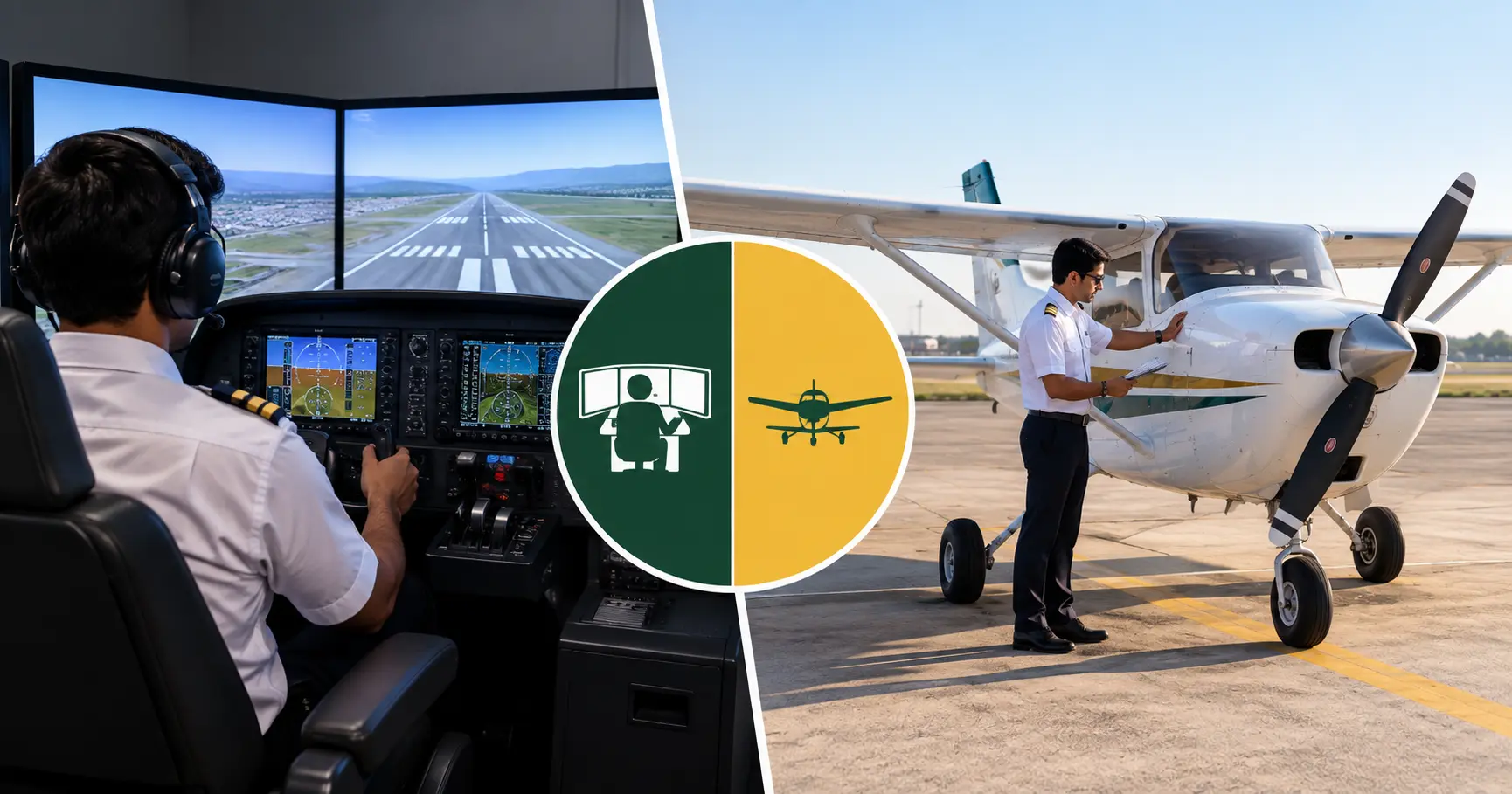
Can simulator hours count towards a CPL in India?
Only a small part of one component. Schedule II, Section J requires 200 total flight hours, and the only simulator allowance sits inside the instrument-time requirement: of those 10 hours, not more than 5 may be on an approved simulator. Every other component — pilot-in-command, cross-country and night flying — must be flown in an actual aeroplane.
The simulator cap, in one view
- •CPL total requirement: 200 hours, Schedule II Section J paragraph 1(e)
- •Instrument-time component: 10 hours, of which up to 5 may be on an approved simulator
- •Pilot-in-command, cross-country and night flying components: no simulator allowance at all
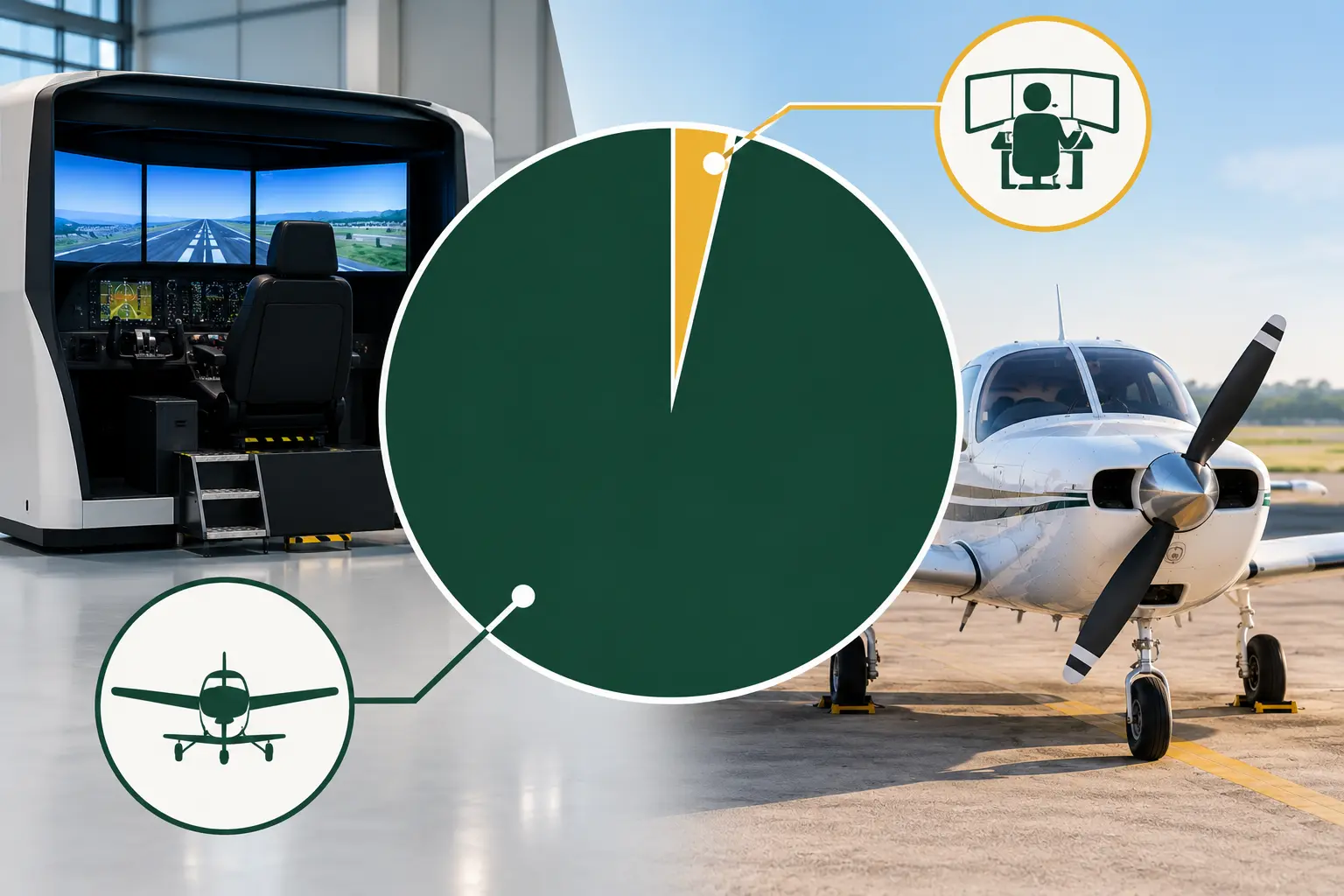
- •That means at most 5 of the 200 hours can be a simulator — 2.5% of the total
- •Instrument Rating, Type Rating and MCC are separate, simulator-heavy qualifications taken after the CPL — none of them draw from or add to the 200-hour total
Can simulator hours count towards a CPL in India?
Only in one narrow place. Every commercial pilot licence in India is issued against Schedule II, Section J of the Aircraft Rules, 1937, and paragraph 1(e) sets a 200-hour total. Inside that total, the only component that allows any simulator time at all is instrument time — and even there, the allowance is capped well below the full requirement.
That single fact is worth being precise about, because it is easy to hear “simulator hours count” and assume it applies more broadly than it does. It does not reduce your pilot-in-command hours, your cross-country requirement or your night flying. Those stay exactly as written, flown in an actual aeroplane.
The question comes up because the word “simulator” is attached to so much of a pilot’s later training — type ratings, MCC, recurrent checks — that it is natural to assume the same logic reaches back into the licence itself. It does not reach back very far. The CPL is, by design, mostly a real-aircraft licence with one small, precisely bounded exception, and knowing exactly where that exception sits is what stops a syllabus quote from being misread.
How the 200-hour CPL requirement breaks down
The 200 hours are not one undifferentiated total — Schedule II specifies four components inside it, each with its own clause. Only one of the four carries any simulator allowance.
| Component | Hours | Clause | Detail |
|---|---|---|---|
| Pilot-in-command | 100 hours | 1(e)(i) | of which not less than 15 hours in the six months before applying |
| Cross-country as PIC | 20 hours | 1(e)(ii) | including one flight of at least 300 nautical miles with full-stop landings at two different aerodromes |
| Instrument time | 10 hours | 1(e)(iii) | of which not more than 5 hours may be on an approved simulator |
| Night flying | 5 hours | 1(e)(iv) | including at least 10 take-offs and 10 landings as pilot-in-command |
Read the instrument-time row again: 10 hours, of which not more than 5 may be on an approved simulator. Every other row — pilot-in-command, cross-country and night flying — carries no such allowance in the notified Schedule. A syllabus that logs simulator time against any of those three is not following Schedule II as written.
It also matters that this is a total, not a set of additions. The 200 hours are the whole requirement, and the four rows above sit inside it rather than stacking on top of it — a distinction some competitor pages get backwards, usually by describing pilot-in-command, cross-country, instrument and night hours as though a student flies all of them separately on top of a base 200. They do not. The rows overlap by design: a single cross-country flight, for instance, can simultaneously count towards pilot-in-command time and towards the 200-hour total. The simulator allowance sits only inside the smallest of the four rows.
Why only 5 hours of simulator time count
The instrument-time requirement exists to test whether you can control an aeroplane using only the instrument panel, with outside visual reference removed. A capable simulator or flight training device reproduces enough of that instrument scan to be a genuinely useful substitute for part of it — which is exactly why the Schedule allows some.
Pilot-in-command time, cross-country navigation and night flying are different in kind. They test judgement and handling in the actual aircraft — real weight, real weather, real consequences of a wrong decision — in a way no device fully replicates. That is the distinction the Schedule draws, and it is why the simulator allowance sits only where it does.
In practical terms: out of 200 hours, at most 5 can be a simulator. That is 2.5% of the total. It is a real allowance, and worth using if your school has a good device, but it is not a route to a materially shorter or cheaper licence.
Simulator use after the CPL is issued
The confusion usually starts here: the training that follows a CPL is genuinely simulator-heavy, and it is easy to assume that pattern extends backward into the licence itself. It does not. Once the CPL is issued, several separate qualifications rely on a simulator far more than the 5-hour allowance above — but none of them are part of the 200-hour CPL total, because they are not the CPL.
The reason the pattern flips so sharply after the licence is issued is that the purpose of the training changes. The CPL tests whether you can fly an aeroplane at all, across a range of real conditions, which is inherently something a device can only partly substitute for. Everything after it — a specific aircraft’s systems, a two-pilot flight deck’s procedures — is exactly the kind of repeatable, procedural training a simulator is built for, which is why the balance shifts so completely once the base licence is behind you.
| Stage | How simulator time is used |
|---|---|
| CPL flight time (Schedule II, Section J) | Capped — only up to 10 instrument hours are eligible, and of those, not more than 5 may be on an approved simulator |
| Instrument Rating | A separate qualification taken after the CPL, with its own procedural syllabus flown largely under a hood or in a simulator — not counted inside the 200-hour CPL total — see our Instrument Rating guide. |
| Type Rating | Aircraft-specific ground school followed by full-flight simulator training and a skill test, arranged after the licence is issued — see our Type Rating guide. |
| Multi-Crew Cooperation (MCC) | Run entirely in a full-flight simulator, since the course exists to train the two-pilot working method rather than handling of a single aircraft — see our MCC training guide. |
Notice the shape of that table: the CPL itself is almost entirely a real-aircraft licence, with one small, clearly bounded simulator allowance. Everything simulator-heavy comes after it, as its own separate qualification with its own approval process and its own cost — not as a way of finishing the CPL faster.
What to check about a school’s simulator before enrolling
A flying school offering simulator sessions as part of your CPL syllabus is not doing anything wrong — the 5-hour allowance is real and worth using. What matters is whether the syllabus respects the cap or quietly exceeds it, and whether the device itself is one the school can actually show is approved rather than a generic training aid described loosely as a “simulator” in a brochure. Four questions expose the answer before you pay for anything:
- Which component is the simulator time being logged against — is it explicitly the instrument-time requirement, or left unspecified?
- How many of the syllabus’s simulator hours are being counted towards the CPL total, and does that number stop at 5?
- Is the device an approved simulator or training device recognised for this purpose, and can the school show that approval?
- Is any simulator time being offered beyond the cap billed and logged separately, as practice rather than as licence hours?
A school that answers all four plainly is running a syllabus that matches Schedule II. One that is vague about which hours count towards what is a syllabus worth double-checking before you commit fees to it.
Common misconceptions about simulator hours
“More simulator time means a cheaper CPL” is the most common one, and it is only true up to the cap. A simulator hour genuinely costs less than an aircraft hour, so a school has a real incentive to schedule as much of your instrument time on the device as the Schedule allows — that is a legitimate saving. Simulator time beyond that 5-hour ceiling does not reduce your CPL hours at all; it is either additional practice you are paying for on top of the 200, or it belongs to a different qualification entirely.
The second misconception is treating “simulator training” as one undifferentiated thing across a pilot’s whole path. A 5-hour allowance inside a student licence, a procedural syllabus for a separate Instrument Rating and a full-flight simulator syllabus for a Type Rating are three different things, governed by three different requirements, at three different points in a career. Confusing them is how students end up expecting a CPL quote to include training that is not the CPL at all — a pattern covered in more detail on our pilot training cost breakdown.
Ground classes at We One Aviation
We have taught the DGCA ground subjects from Dwarka since 2009. We arrange flight training with partner flying schools rather than operating aircraft or simulators ourselves, which is exactly why we point students at clauses rather than at a device — the Schedule is the same wherever you fly, and knowing it before you enrol is what lets you read a syllabus correctly.
We teach the DGCA ground subjects and arrange flight training with partner flying schools. We do not own aircraft or simulators, we do not employ pilots, and we do not place students into airline jobs — hiring decisions rest with the operator.
People also ask
Does simulator time count as pilot-in-command hours for CPL?
No. Schedule II, Section J, paragraph 1(e)(i) requires 100 hours as pilot-in-command, and that clause is written around actual flight time in an aeroplane. Simulator sessions have no bearing on this component at all — they are only relevant to the instrument-time requirement below.
How many simulator hours are allowed inside the CPL 200-hour total?
Up to 5, and only as part of the 10-hour instrument-time requirement under paragraph 1(e)(iii). That is 5 hours out of a 200-hour total — a small fraction, not a training track you can lean on to shorten the course.
Do Type Rating and MCC simulator hours count towards the CPL?
No. Both are separate qualifications taken after the CPL is issued, arranged with a DGCA-approved training organisation, and neither adds to or draws from the 200-hour CPL total. They exist to prepare you for a specific aircraft or a multi-pilot flight deck, not to satisfy the licence itself.
Can cross-country or night flying hours be done on a simulator?
No. Paragraphs 1(e)(ii) and 1(e)(iv) — the cross-country and night flying components — are not eligible for simulator substitution under Schedule II. Only the instrument-time component carries a simulator allowance, and it is capped at 5 of its 10 hours.
Does more simulator time in a course mean a cheaper CPL?
Only within that 5-hour cap — a simulator hour is genuinely cheaper than an aircraft hour, which is exactly why some quotes lean on it. Beyond the cap it has no bearing on your licence hours at all, so a school padding a syllabus with simulator sessions is not shortening your 200-hour requirement, only its own costs.
Related guides
- For the separate qualification that most simulator hours actually go towards, read our Instrument Rating guide
- For how a Type Rating uses full-flight simulator training after the licence, see our Type Rating guide
- For where simulator hours sit inside the full training budget, see our pilot training cost breakdown
- For the DGCA ground classes that come before any of this see our ground classes page
- For the licence itself and how it is structured see the commercial pilot licence page