Pilot career guide
Multi-Engine Rating for Pilots in India: What It Is and Why CPL Holders Need One
By We One Aviation Academy · Published · 8 min read
Last updated:
Quick Answer
What is a multi-engine rating and why do CPL holders need one?
A multi-engine rating is a class-rating endorsement certifying a pilot to handle a category of twin-engine aeroplanes, including asymmetric flight after an engine failure. A CPL alone trains single-engine flying. Since every Indian airline operates multi-engine, multi-pilot aircraft, this rating sits between a bare CPL and eligibility for a First Officer role, usually earned alongside an Instrument Rating and before a type rating.
The essentials, in one view
- •A multi-engine rating is a class rating — it covers a category of twin-engine aeroplanes, not one specific aircraft model
- •Prerequisites: a current Commercial Pilot Licence (minimum age 18) or final-stage CPL training, plus a valid DGCA medical certificate
- •Training is flown on an actual twin-engine aircraft, not a single-engine trainer, and ends with a DGCA skill test
- •It is distinct from an Instrument Rating (flying by instruments) and a type rating (one specific aircraft model)
- •Airlines require it because every Indian carrier flies multi-engine, multi-pilot aircraft — it is one of the standard steps before a First Officer seat
- •DGCA does not publish one universal hour or fee figure for this training — get a written, itemised quote from the school directly

What is a multi-engine rating?
A multi-engine rating is an endorsement on a pilot’s licence certifying they are qualified to act as pilot on an aeroplane with more than one engine. Every hour behind a standard 200-hour Commercial Pilot Licence in India is flown on a single-engine trainer, so the licence itself proves nothing about handling a second engine, the systems that come with it, or what happens when one of the two stops producing power mid-flight. The rating exists specifically to close that gap.
It sits on top of the CPL rather than being part of it, and — like a type rating — it is trained and tested separately from any DGCA written paper or the licence issue itself.
Class rating vs type rating
A multi-engine rating is a class rating, not a type rating, and the distinction is worth being precise about because the two get used interchangeably in casual conversation. A class rating covers a category of aeroplanes that share broadly similar handling characteristics — light twin-engine aircraft, in this case — regardless of the specific model. A type rating certifies one specific aircraft model, such as a particular airliner, and does not transfer to a different model even within the same broad category.
In practice this means a multi-engine rating earned on one light twin generally covers other aeroplanes in the same class, while a type rating earned on one airliner covers that airliner alone. A pilot moving from a light twin to an airliner still needs a separate type rating for it — the multi-engine rating is what gets them eligible to start that process, not a substitute for it.
Why do CPL holders need one?
Because Indian carriers do not operate single-engine aircraft. Every scheduled airline fleet in the country is multi-engine and multi-pilot, so a First Officer candidate needs to demonstrate multi-engine handling before an airline or a Type Rating Training Organisation will take them further. A fresh CPL holder’s single-engine hours, however many of them there are, do not by themselves show that.
The rating typically arrives close to an Instrument Rating in a pilot’s training sequence, and both usually precede a first type rating — see our type rating guide for where a multi-engine rating sits among that course’s own prerequisites.
What you need before you start
A school offering multi-engine training checks each of these before accepting a candidate. Missing one does not fail the course — it stops you from starting it.
| Requirement | Detail |
|---|---|
| Commercial Pilot Licence | Current and unrestricted, or in the final stage of CPL training at an organisation that also offers multi-engine training. Minimum age for CPL issue is 18 (Aircraft Rules, 1937, Section J). |
| DGCA medical certificate | A valid medical assessment current on the day of training and the skill test, not merely at CPL issue. |
| Aircraft-specific ground briefing | Systems, performance and emergency procedures for the particular twin-engine aircraft used for training — covered before flight training begins, not examined as a separate DGCA written paper. |
| A DGCA-approved organisation offering multi-engine aircraft | Not every flying school operates a twin. Confirm the school’s current approval covers multi-engine training specifically, not only single-engine CPL hours. |
What the training actually involves
The course is flown on the twin itself, not a single-engine trainer, and it builds toward one specific skill: handling the aircraft safely if one engine fails.
| Stage | What it involves |
|---|---|
| Ground briefing | Systems specific to the twin — a second engine, its fuel and electrical feed, and the performance and limitations that come with it. |
| Normal handling | Take-off, climb, cruise, descent and landing on the twin, building the handling reference a single-engine CPL course never required. |
| Asymmetric flight | Flying with one engine deliberately reduced to simulate a failure — the core skill a multi-engine rating exists to certify, since a twin behaves very differently on one engine than on two. |
| Engine-out procedures and emergencies | Identifying, confirming and responding to a simulated engine failure at various stages of flight, to the standard the skill test checks. |
| Skill test | A DGCA-authorised examiner checks handling, asymmetric procedures and emergency response before the rating is endorsed on the licence. |
DGCA does not publish a single universally quoted minimum-hour figure for this training that this guide could verify against a primary source, and providers describe their own syllabi in different terms. Confirm the current hour count and structure directly with the school before enrolling, rather than planning around a number seen on a forum or a third-party blog.
Multi-engine rating vs Instrument Rating vs type rating
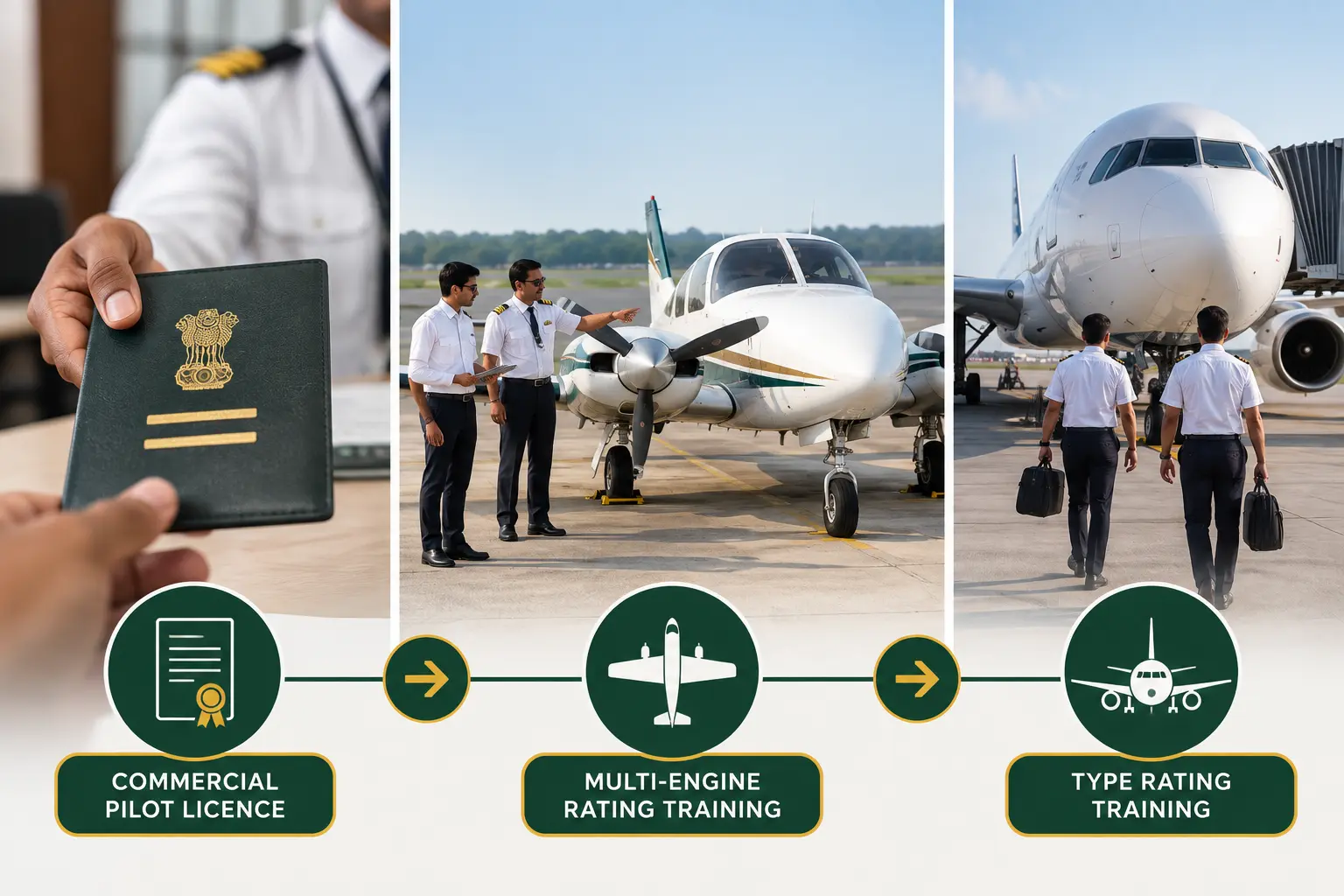
These three are the ratings a CPL holder most often confuses, because a career adds all three within a fairly short span. They train different things and none substitutes for another.
| Aspect | Multi-engine rating | Instrument Rating | Type rating |
|---|---|---|---|
| What it certifies | Handling a category of light twin-engine aeroplanes — asymmetric flight and engine-out procedures | Flying solely by reference to instruments, without visual reference to the horizon or ground | Acting as a crew member on one specific aircraft model |
| Aircraft-specific? | No — a class rating, covering aeroplanes that share handling characteristics | No — the skill applies across aircraft you are otherwise qualified to fly | Yes — endorsed for one type, and often one variant |
| Where it is trained | On an actual twin-engine aircraft, at a school approved to offer one | On a single or multi-engine aircraft and simulator, depending on the provider | DGCA-approved Type Rating Training Organisation (TRTO), mostly in a simulator |
| Typically taken | Once, usually straight after CPL and before a first multi-pilot type rating | Once, often close to the multi-engine rating in the same training phase | Each time a new aircraft type is added |
For what an Instrument Rating trains on its own, see our Instrument Rating guide. For the two-pilot working method a multi-pilot type rating and MCC add on top of both, see our MCC training guide.
What does a multi-engine rating cost?
There is no single reliable figure. DGCA does not standardise or publish multi-engine training fees, and quotes gathered from different Indian schools for what is, on paper, the same rating disagreed with each other by a wide margin — enough that repeating any one of them here would risk stating a number a different provider could contradict within weeks. Rather than pick a figure from a disagreeing set of sources, the honest answer is: request a written, itemised quote from the specific school, on the specific aircraft, before committing.
At minimum, ask what the quote includes — ground briefing, the full flight-training syllabus, and the skill test itself — and whether the aircraft is a piston twin or a turboprop, since the two are priced very differently per hour.
Choosing where to train
Not every flying school that trains CPL students also operates a twin. Availability, not price, is usually the first filter.
- Confirm the school’s current DGCA approval covers multi-engine training, not only single-engine CPL hours.
- Ask how many twin-engine aircraft the school operates and their typical serviceability — a rating course stalls quickly if the one twin on the line is frequently down for maintenance.
- Check whether asymmetric training is flown to full engine-shutdown standard or only to a reduced-power simulation, and ask the school to explain the difference if it is not clear from the answer.
- Ask whether the same slot can be used to work toward an Instrument Rating on the twin, since some schools combine the two efficiently and others do not.
Mistakes that waste the investment
- Enrolling before confirming the school actually operates a twin currently approved for the rating, rather than one it once offered.
- Treating a quoted fee as final without asking whether ground briefing and the skill test are included or billed separately.
- Assuming the rating includes instrument privileges — it does not, and flying a twin under instrument conditions still needs a separate, current Instrument Rating.
- Delaying it until an airline application is already in progress, rather than sequencing it alongside the Instrument Rating well before that stage.
- Choosing a school on price alone without checking aircraft serviceability, since a grounded twin costs more in lost time than a slightly higher hourly rate elsewhere.
Ground classes at We One Aviation
We have taught the DGCA ground subjects from Dwarka since 2009. A multi-engine rating sits after the stage we teach, but planning questions like when to fit it in alongside an Instrument Rating and a first type rating are exactly the kind of conversation we have with students long before they reach that stage.
We teach the DGCA ground subjects and arrange flight training with partner flying schools. We do not own aircraft or simulators, we do not employ pilots, and we do not place students into airline jobs — hiring decisions rest with the operator.
People also ask
Is a multi-engine rating compulsory for an airline job in India?
In practice, yes. Indian carriers operate multi-engine, multi-pilot aircraft exclusively, so a First Officer candidate needs a multi-engine rating before they can be considered for that seat. It sits alongside an Instrument Rating and, later, a type rating as one of the standard steps between a bare CPL and an airline cockpit.
Does a multi-engine rating include an Instrument Rating?
No. A multi-engine rating trains handling a second engine — asymmetric flight, engine-out procedures and the systems that come with a twin — while an Instrument Rating trains flying solely by reference to instruments. Most career pilots hold both, but they are separate endorsements earned through separate training, and one does not substitute for the other.
What licence do I need before starting multi-engine training?
A current Commercial Pilot Licence, or being in the final stage of CPL training at a school that offers it, along with a valid DGCA medical certificate. A multi-engine rating is an add-on to a licence you already hold or are about to hold, not a licence in itself.
Does a multi-engine rating replace a type rating?
No. A multi-engine rating is a class rating — it covers handling characteristics common to a category of light twin aeroplanes. A type rating certifies one specific aircraft model, such as a particular airliner, and is a separate qualification you add afterward, usually with the multi-engine rating as one of its own prerequisites.
Does We One Aviation provide multi-engine rating training?
No. We teach the DGCA ground subjects and prepare students for the written examinations. A multi-engine rating is flown on an actual twin-engine aircraft at an organisation approved to offer it, and is arranged as a separate stage from ground school.
Related guides
- For what a type rating is and how a multi-engine rating fits as one of its prerequisites, read our type rating guide
- For the separate Instrument Rating and how it differs from multi-engine handling, see our Instrument Rating guide
- For the two-pilot working method airlines require before line training, read our MCC training guide
- Every line item in a CPL budget, including where ratings sit outside it, is on our pilot training cost breakdown
- For CPL eligibility, ground subjects and the six-month syllabus, see the CPL course page